



Giovanna Crippa
Product Manager Europe
Write
Choose which cookies you accept. Privacy policy
Audience measurement
Google Analytics and Matomo cookies — journeys, searches and bookings.
Targeted advertising
Google Ads, Meta and Effinity — conversions, personalised ads and campaign attribution.
Travel assistant
AI-generated answers. Check important information on our information pages, in your contract or with a human advisor at Kelifos.
AI answers — when in doubt, ask an advisor.


The Peloponnese is Greece in all its depth: ancient theatres where voices still carry after two and a half thousand years, Byzantine fortresses suspended above the sea, olive groves stretching to the horizon, and Mani villages where stone towers stand against a sky of intense blue. Here, every path links a listed site to a village taverna, every vista tells a chapter of history. Our walking holidays invite you to explore this mythical peninsula at the rhythm it deserves: one of discovery, wonder and the pleasure of the table, whether on a guided trip or self-guided.



From US$783
From Price on request
5 · 1 review
No trips found for these criteria.
None of these quite the trip you had in mind?
Our specialists build the itinerary around you — dates, pace, accommodation, all of it adapts.
Giovanna Crippa
Product Manager Europe
Kristiina Gaillard
Greece & Mediterranean specialist
Laura Kankaanpää
Greece & Mediterranean specialist
The Peloponnese concentrates a density of ancient sites without equal in the Mediterranean. But far from a museum atmosphere, these places reveal themselves on foot, in their natural setting, with an emotion that photographs never quite capture.
Epidaurus and its theatre with perfect acoustics, nestled in a pine-planted valley, invites you to sit on the stone tiers and listen to the silence. Mycenae, with its Lion Gate and Cyclopean walls, transports you to the time of legendary kings. Olympia, birthplace of the Games, spreads its broken columns and wild olive trees across a peaceful plain where you can picture the athletes of antiquity.
But the Peloponnese is far more than its ruins. The fortified town of Monemvasia, nicknamed the “Greek Gibraltar”, is a medieval jewel clinging to a rock linked to the mainland by a narrow causeway. You wander through cobbled lanes lined with carefully restored houses, discover Byzantine churches adorned with frescoes, and sit down at a charming address facing the sea, a glass of Nemea wine in hand.
The Mani peninsula, the southern tip of the Peloponnese, is a world apart. An arid and proud land, it raises its fortified villages (the celebrated stone towers of the Maniots) against the sea, in a mineral landscape of austere and captivating beauty.
The coastal paths of the Mani follow sheer cliffs, pass pebble coves accessible only on foot, and connect hamlets where time seems suspended. At Kardamyli, gateway to the outer Mani, stone houses converted into charming addresses welcome travellers in a setting of absolute serenity. It was here that the writer Patrick Leigh Fermor chose to settle, captivated by the light, the sea and the hospitality of the locals.
Further south, the inner Mani (or deep Mani) reveals near-deserted villages, rock-hewn chapels adorned with frescoes, and the Diros caves, underground labyrinths explored by boat on a subterranean lake. This is a confidential Greece of rare authenticity, which our trips let you discover in comfort.
The Peloponnese is a paradise for epicureans. The region produces some of Greece’s finest olive oils (notably the Kalamata appellation), renowned wines such as the red Nemea from the Agiorgitiko grape, and fragrant citrus fruits that perfume the markets of Nafplio.
Peloponnesian cuisine celebrates simple produce, prepared with love. Kalamata olives, plump and melt-in-the-mouth, accompany every meal. Sun-gorged tomatoes, sfela cheese (a piquant cousin of feta), and wild herbs gathered from the hills compose meze shared with joy.
In Nafplio, the first capital of modern Greece, the old Venetian town restaurants offer refined cuisine that blends local tradition with creativity. You savour grilled octopus facing the Bourtzi fortress, perched on its islet in the middle of the bay, then climb the flower-filled lanes to an artisan gelateria for a citrus ice cream made from the neighbouring orchard.
The Peloponnese is explored like a book where every chapter holds a surprise. Beyond Epidaurus and Mycenae, already mentioned, the peninsula abounds with places where you love to linger, a Greek coffee in hand, your gaze resting on centuries of history.
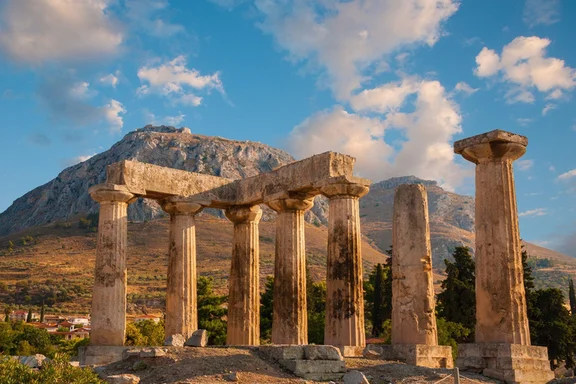
Corinth marks the threshold of the Peloponnese. Its canal, a streak of turquoise light cut into the rock, has separated the peninsula from the mainland since the late 19th century. Above the modern town, Acrocorinth commands the heights: this massive fortress, successively Roman, Byzantine, Venetian and Ottoman, offers from its summit a breathtaking panorama over the Gulf of Corinth and the mountains of the Argolid. You climb by a paved path bordered with wildflowers, in a silence broken only by the wind.
Further south, at the foot of the Taygetos, Mystras is a revelation. This Byzantine citadel perched on a rocky spur, a UNESCO World Heritage Site, was the intellectual and artistic capital of the dying Byzantine Empire. Its churches with sumptuous frescoes, its ruined palaces invaded by fig trees, and its cobbled lanes compose a setting of melancholic beauty. Visit Mystras in the early morning, when the mist lifts over the plain of Sparta below, and you understand why 15th-century philosophers chose this place to teach.
Nafplio, already celebrated for its gastronomy, deserves a longer stop. The ascent to the Palamidi fortress via its 999 steps (or by car, for the wiser) rewards you with a magnificent panorama over the bay, the ochre rooftops of the old town and the distant mountains. You descend to stroll the Venetian lanes, admire the carved wooden balconies, then settle on a terrace in Syntagma Square to savour a warm loukoumades.
As for Olympia, mentioned earlier, it reveals itself fully during a morning walk among Doric columns and centuries-old olive trees. The archaeological museum, one of the finest in Greece, houses the pediments of the Temple of Zeus, masterpieces of classical sculpture contemplated in reverent silence.
At the heart of the peninsula, far from the tourist coasts, Arcadia lives up to its mythical name. This mountainous region, crossed by torrents and carpeted with oak and fir forests, shelters stone villages that seem not to have moved in two centuries. This is the confidential Peloponnese, discovered with the joy of a traveller who strays from the beaten track.
Dimitsana, clinging to the mountainside above the Lousios Gorge, is a village of character with stone houses topped by red tiles. Its historic library, one of the oldest in Greece, preserves rare manuscripts testifying to the village’s intellectual role during the Ottoman occupation. A few lanes away, the old powder magazine recalls that Dimitsana supplied gunpowder to the fighters of the 1821 War of Independence. You then sit down in a family taverna to taste the local coq au vin, accompanied by trachana (fermented wheat soup), warming and comforting.
Twenty minutes by road, Stemnitsa captivates with its calm and artisan heritage. Goldsmiths and silversmiths carry on centuries-old skills. Stone-paved lanes lead to squares shaded by plane trees where time passes with a sweetness that is entirely Greek.
Between the two villages, the Lousios Gorge carves a spectacular furrow through the mountain. Clinging to the cliff walls, the monasteries of Philosophou and Prodromou defy gravity. You reach Prodromou by a path cut into the rock, then pass through a low door to discover a tiny courtyard, time-patinated frescoes and a monastic silence broken only by the song of the river below. These mule tracks, carefully restored, offer immersion in a landscape where nature and heritage blend in rare harmony.
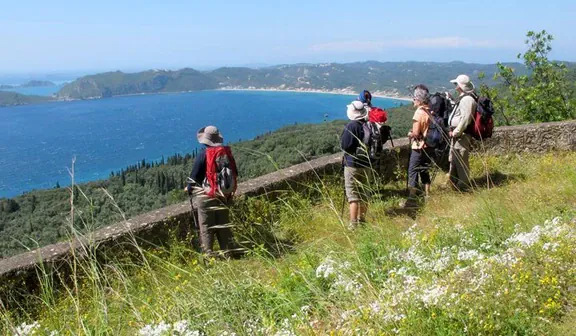
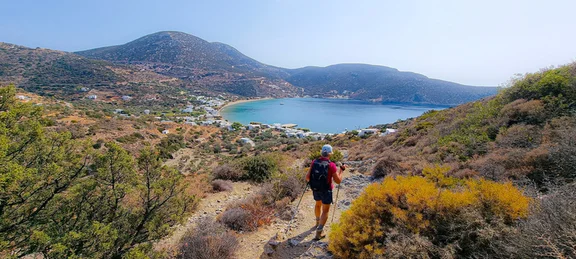
The Peloponnese lends itself beautifully to gentle strolls. Here, there is no need to be athletic: the paths invite wandering, contemplation and pauses under an olive tree to bite into a fig picked at the roadside.
The coastal path of the Mani, from Kardamyli to Stoupa, is one of the most beautiful walks in Greece. The path follows the coast from above, descends to pebble coves where you swim in complete tranquillity, crosses centuries-old olive groves and white chapels facing the sea. Allow three to four hours of easy walking, with pauses as long as you wish. The arrival at Stoupa, beside a sandy beach, calls for a lunch of grilled fish with your feet almost in the water.
The Lousios Gorge offers a walk of quite a different character. The path, sometimes narrow, winds between rock walls carpeted with moss, crosses small stone bridges and leads to the cliff-hanging monasteries. The coolness of the gorge contrasts with the warmth of the plateaux: you walk in filtered light, cradled by the murmur of the torrent.
On the foothills of the Taygetos, accessible sections let you enjoy grand vistas without aiming for the summit. From the heights above Mystras, your gaze sweeps the plain of Sparta, the endless olive groves and, on a clear day, the sea in the distance. The morning light there is of extraordinary purity.
Finally, the walk around Monemvasia combines heritage and seafront. You follow the ramparts of the lower citadel, climb to the upper town by a paved path bordered by romantic ruins, and descend via the south coast, facing the Aegean. In the evening, you settle in a courtyard of the old town for a candlelit dinner, enveloped by the scent of jasmine.
The Peloponnese is a compact but hilly peninsula, where distances in kilometres do not tell the whole story. The roads, often winding, pass through landscapes so beautiful that the journey becomes part of the trip.
From Athens, Nafplio is reached in about two hours via the motorway, and it is the most natural gateway to the Peloponnese. From Nafplio, allow roughly two and a half hours to reach Monemvasia to the south, or an hour and a half for Mystras and Sparta. Kalamata, on the west coast, is accessible in three hours from Nafplio, or directly from Athens by train, a comfortable option that follows the coast of the Gulf of Corinth.
A hire car offers the greatest freedom. It allows you to stop on a whim: a coffee beside an Ottoman bridge, a photo in front of a field of orange trees in blossom, a detour through a village no one mentioned in the guidebook. The roads are well maintained and the signposting reliable.
For those who prefer to travel with a clear mind, our guided trips and self-guided holidays include the organisation of transfers between stages. Your luggage awaits you at each charming address, and detailed route notes guide you day by day. You simply enjoy the path, the encounters and the terroir flavours.
The Peloponnese is ideally discovered in spring (March to June) and autumn (September to November). The gentle seasons bring perfect temperatures for walking, incomparable light on the ancient sites, and the chance to swim in a sea still warm in autumn.
Our guided trips gather a small group of epicureans around an English-speaking guide passionate about history and gastronomy. On a self-guided trip, you have detailed route notes, carefully selected charming addresses and your luggage transferred between each stage. Cycling enthusiasts will appreciate the coastal roads of the Mani and the plains of the Argolid, with the e-bike option for optimal comfort.
To extend the adventure, the Cyclades, Crete and the Ionian Islands await for an island chapter. Our advisors will compose the ideal itinerary with you.
Find all our destinations from our home page.
Isabelle 12/27/25 • The Peloponnese: ancient heritage and Greek sweetness of life
— A wonderful trip that harmoniously combines short hikes and the discovery of heritage sites. We often approached them on foot, which made the experience all the more memorable. Many thanks to our guide, Jérémy, who accompanied us with great kindness, goodwill and energy, and who passed on to us his passion for Greece. We couldn't have been better accompanied to discover the archaeological and natural heritage, as well as the gastronomic delights!
—
— Reply from the team

From Price on request

From Price on request
From Price on request

From US$783
From Price on request
3,8 · 5 reviews
From US$1,036
4,6 · 20 reviews
Your next adventure
Confirmed trips only
No trip matches — let us guide you Need help choosing?
Call us
Receive our best travel inspirations and expert tips straight to your inbox.
Your weekly dose of travel inspiration.