



Laura Kankaanpää
Greece & Mediterranean specialist
Write
Choose which cookies you accept. Privacy policy
Audience measurement
Google Analytics and Matomo cookies — journeys, searches and bookings.
Targeted advertising
Google Ads, Meta and Effinity — conversions, personalised ads and campaign attribution.
Travel assistant
AI-generated answers. Check important information on our information pages, in your contract or with a human advisor at Kelifos.
AI answers — when in doubt, ask an advisor.


Picture a shaded terrace overlooking the caldera, a glass of Assyrtiko wine in hand, the evening light gilding the domes of Santorini. In the Cyclades, every day begins with the scent of wild thyme and ends in the gentle warmth of a village taverna. Our walking holidays invite you to savour this archipelago at the rhythm it deserves: one of wandering, curiosity and shared pleasure. Whether you choose a guided trip or a self-guided escape, every charming address, every coastal path, every plate of meze has been chosen to offer you the finest of island Greece.



From US$1,036
4,6 · 20 reviews

From US$1,171
4,5 · 2 reviews

From US$1,648
4,6 · 20 reviews
From Price on request
5 · 6 reviews

From US$1,307
4,5 · 2 reviews
From Price on request

From Price on request

From Price on request
No trips found for these criteria.
None of these quite the trip you had in mind?
Our specialists build the itinerary around you — dates, pace, accommodation, all of it adapts.
Laura Kankaanpää
Greece & Mediterranean specialist
Giovanna Crippa
Product Manager Europe
David Praire
CEO
Kristiina Gaillard
Greece & Mediterranean specialist
People often think of the Cyclades for their beaches and sunsets. But the true treasure of the archipelago lies in its kalderimia, those marble-paved paths that have linked villages for centuries. These are hidden paths made for strolling, not for performance: a few hours of walking are enough to connect two hamlets, pause before a whitewashed chapel, taste goat cheese offered by a shepherd.
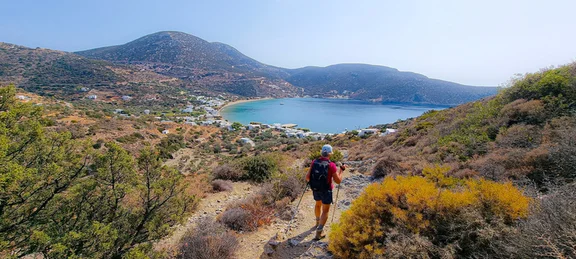
On Sifnos, renowned as the gastronomic capital of the Cyclades, the paths wind between artisan potteries and hilltop monasteries. The island has over a hundred churches, each a contemplative pause before finding a seaside table to savour the celebrated revithada, a chickpea stew slow-cooked overnight in a wood-fired oven.
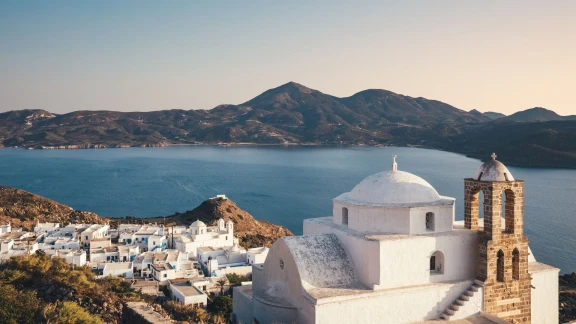
Serifos surprises with its terraced olive groves facing the deep blue of the Aegean. More secretive, less visited, it offers that rare feeling of having an island to yourself. Milos, with its wind-sculpted rock formations and turquoise coves, delights the curious and lovers of natural geology.
Further east, Naxos unfolds its citrus orchards and mountain villages where time seems suspended. Amorgos, wild and unspoilt, invites contemplation from the monastery of Panagia Hozoviotissa, clinging to the cliff above the sea.
The Cycladic archipelago counts some fifty islands, around twenty of which are inhabited. Each possesses its own character, its terroir, its landscapes. Here are those that especially deserve the detour.
Santorini is undoubtedly the most famous island in Greece. Its caldera, the vestige of a volcanic eruption some 3,600 years ago, creates a vista of striking beauty. The villages of Fira and Oia, perched on the cliff edge, offer those sunsets the world has come to know. But Santorini holds many other treasures: Assyrtiko vineyards grown in low baskets on the volcanic soil, the archaeological site of Akrotiri (dubbed the Greek Pompeii), the black sand beaches of Kamari. The island lends itself beautifully to walking, between ridgeline paths and vineyard terraces.
Sifnos is the gastronomic capital of the Cyclades. Here, cooking is an art of living handed down through generations. The island’s paved paths connect villages with immaculate facades, isolated monasteries and pottery workshops where local clay takes shape under artisan hands. The revithada, a chickpea stew slow-cooked overnight in a wood-fired oven, is a must. Sifnos captivates with that rare alliance of culinary heritage, village authenticity and gentle walking trails.
Naxos is the largest and greenest of the Cyclades. Mount Zas, the highest point in the archipelago (1,004 m), overlooks fertile valleys planted with olive and citrus trees. Mountain villages such as Halki, Filoti and Apiranthos preserve the atmosphere of deep Greece, far from the bustle of beach resorts. You taste local cheeses, visit Venetian towers, lose yourself in flower-filled alleyways. Naxos is the ideal island for travellers who love to combine highland walks with long stretches of sandy beach.
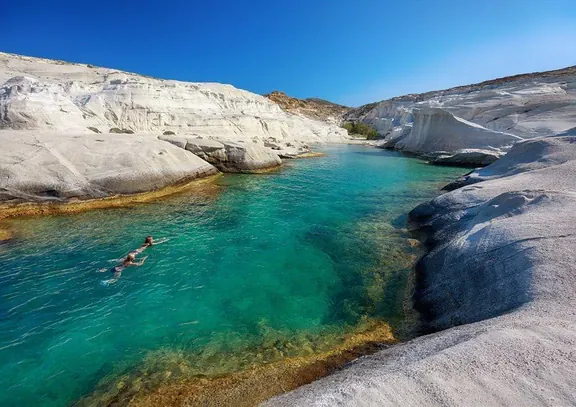
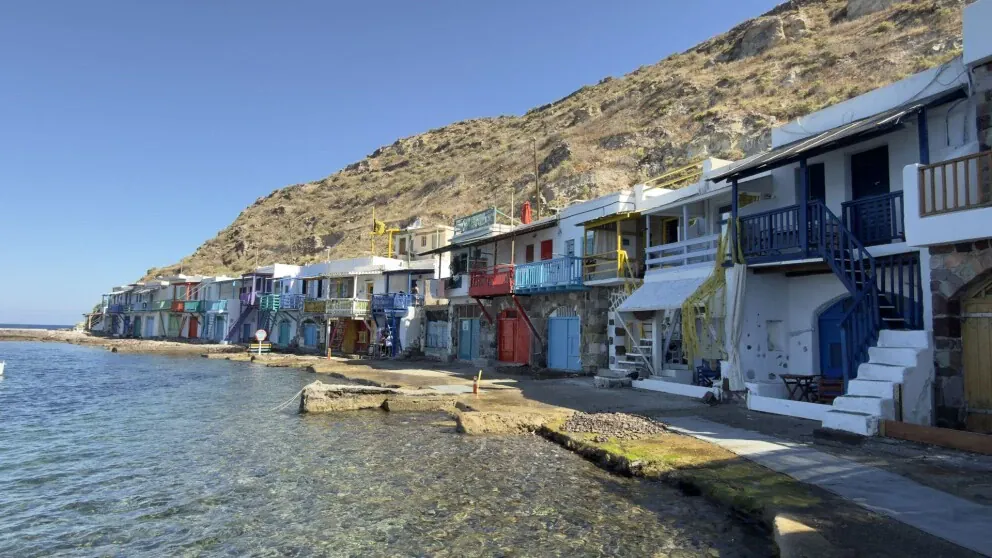
Milos fascinates with its almost otherworldly landscapes. The white cliffs of Sarakiniko, sculpted by wind and waves, evoke a lunar setting. The sea caves of Kleftiko, accessible only by boat, rank among the most spectacular sites in the Mediterranean. The island also has a rich mining past and colourful fishing villages (the syrmata) where boats rest in garages carved into the rock. Milos offers total change of scenery, between fascinating geology and secret coves.
Serifos remains one of the most secretive islands of the archipelago. Its Chora, perched atop a hill, is considered one of the most beautiful villages in the Cyclades. Paths cross olive terraces and skirt old mines that bear witness to the island’s industrial past. Here, no crowds, no noise: just the song of the cicadas, the deep blue of the Aegean and that serenity which is the very charm of the Cyclades off the beaten path.
Amorgos captured the world’s imagination through Luc Besson’s film The Big Blue. The island remains true to that image of a place at the edge of the world, wild and unspoilt. The monastery of Panagia Hozoviotissa, clinging to a vertiginous cliff above the sea, is one of the most striking monuments in all of Greece. The walking paths cross arid and grandiose landscapes, punctuated by isolated chapels and turquoise coves.
Paros offers a perfect balance between liveliness and authenticity. The port of Naoussa, with its paved lanes and waterside restaurants, is one of the most charming in the archipelago. The inland villages of Lefkes and Marpissa maintain a peaceful atmosphere. Paros is also an ideal base for island-hopping: ferry connections are plentiful, and the neighbouring island of Antiparos deserves a day trip.
The journey to the Cyclades almost always begins in Athens. From the UK and US, several daily flights connect to the Greek capital in around three to four hours. In season, a few direct flights serve Santorini, Mykonos or Naxos, but routing through Athens remains the most flexible option for a tailor-made itinerary.
From Piraeus, the great port of Athens, ferries depart daily for the entire archipelago. Journey times vary by island and vessel type. For Sifnos, allow approximately five hours by classic ferry (Blue Star Ferries) or two and a half hours by speed boat (SeaJets, Aegean Speed Lines). Naxos is four hours by classic ferry, two hours by fast catamaran. Santorini requires a little more patience: around eight hours on the classic line, five hours by fast boat. The classic ferry, though slower, offers the advantage of spacious open decks and a gentle arrival, with time to watch the archipelago take shape on the horizon.
Inter-island connections are frequent in season (April to October), allowing you to combine two or three islands in a single trip. Blue Star Ferries operates the main routes with regularity, while SeaJets and other fast companies complement the service. A classic itinerary might link Sifnos and Serifos (one hour crossing), or Naxos and Amorgos (around two hours).
At Kelifos, we arrange all your transfers: ferry tickets, airport welcome, shuttles to the port. You simply set down your suitcase and enjoy the crossing. Our advisors know the timetables, the best companies and the most pleasant combinations for composing your island itinerary.
The Cyclades are a playground for escape that extends well beyond the walking paths. The archipelago brims with cultural, gastronomic and natural treasures that enrich every day of your trip.
Culture and heritage. The island of Delos, a UNESCO World Heritage Site, is one of the most important archaeological sites in the Mediterranean. This ancient sanctuary, mythological birthplace of Apollo, can be visited on a half-day excursion from Mykonos or Naxos. On Santorini, the site of Akrotiri reveals a Minoan city buried beneath volcanic ash, with frescoes of remarkable finesse. Each island also has its own small museum, its Byzantine chapels, its Venetian remains: the heritage of the Cyclades unfolds at every turn of a walk.
Flavours and terroir. Cycladic gastronomy is a permanent invitation. On Sifnos, the culinary tradition is so rich that an entire festival is dedicated to it each September. Local cheeses (the piquant kopanisti, the creamy xinomyzithra) accompany every meal. The volcanic vineyards of Santorini produce dry white wines of unique minerality. Octopus, sun-dried on taverna terraces then grilled over charcoal, is a ritual on every island. Santorini capers, Serifos thyme honey, Amorgos dried figs: each flavour tells the story of a terroir.
Beaches and crystal waters. The Cyclades offer a remarkable diversity of beaches. The white rocks of Sarakiniko on Milos, the sea caves of Kleftiko accessible by boat, the long sandy stretch of Plaka on Naxos: each island holds its surprises. The crystal-clear waters invite snorkelling, requiring nothing elaborate, just a mask and the pleasure of gliding above rocky seabeds alive with colourful fish.
Local craftsmanship. The Cyclades perpetuate ancient skills. On Sifnos, potters have been shaping clay since antiquity, and their workshops remain open to curious visitors. On Naxos, jewellers work gold and silver drawing on millennia-old Cycladic motifs. Bringing home a handmade object is a way to prolong the journey and support the authenticity of these islands.
The Cyclades reveal their most beautiful face in spring (April to June) and autumn (September to October). These are the seasons we favour for our trips, and for good reason.
In spring, the hills are covered with wildflowers, temperatures remain pleasant for walking without the summer heat, and the islands live at their natural rhythm, far from the peak-season crowds. It is also the season of village festivals, colourful markets and the first swims in already-warm water.
Autumn brings an incomparable light, lower and more golden, that transforms every vista into a painting. The sea, warmed by summer, invites swimming stops after a walk. The tavernas serve the last figs, fresh capers, just-harvested grapes. The rhythm is slower, more intimate: it is the favourite season of travellers who love to take their time.
Our guided trips gather a small group of epicurean travellers around an English-speaking guide who knows every island like the back of their hand. They open the doors of artisan workshops, take you to tavernas that only locals frequent, and share the stories and legends of each place along the way. Transfers between islands, charming addresses, meals: everything is orchestrated so you need only enjoy.
On a self-guided trip, you compose your days as you please. Detailed route notes, accommodation reserved in boutique hotels, your luggage waiting at each stop: freedom without the unexpected. You walk in the morning, swim in the afternoon, stroll through the lanes in the evening. And if a village charms you more than another, nothing stops you from lingering longer.
For those who prefer two wheels, our cycling holidays offer another way to explore the islands. With the e-bike option, the climbs to hilltop villages become a pleasure rather than an effort, and the descents towards the coves reveal breathtaking vistas. It is an ideal approach for covering more ground while keeping that gentle rhythm which is the hallmark of a Kelifos holiday.
The Cyclades are just one chapter of the Greek adventure. In Crete, spectacular gorges and mountain plateaux sit alongside one of the richest culinary traditions in the Mediterranean. The Ionian Islands, greener and lusher, captivate with their cypress forests, Venetian villages and waters of an almost unreal blue. Each archipelago has its personality, its terroir, its flavours. Our advisors, true connoisseurs of Greece, will help you find the island that speaks to you.
Find all our destinations from our home page.
Jean-Michel 6/23/26 • Serifos, Sifnos and Milos at your own pace: 10 days in the western Cyclades
— These are some really beautiful hikes, but June 10–19 is a little too late in the season because of the heat. For most of the hikes, it’s impossible to set out early due to bus schedules and breakfast times at the hotels.
Cathy Minois 12/27/25 • Cyclades Dream: Sifnos, Milos and Kimolos at their finest
— Magnificent trip. Beautiful scenery. Good balance between hiking, swimming and resting. Mathieu is an excellent guide and a very nice person. Very professional and attentive. Sifnos and Kimolos are two very unspoilt and wild islands.
—
— Reply from the team
— The itinerary was wonderful, and the choice of hotels was spot-on and exactly what we wanted: small, family-run, and in great locations.
Blandine 7/31/26 • Serifos, Sifnos and Milos at your own pace: 10 days in the western Cyclades
— Enjoyable, well thought out, good pace
—
— Reply from the team

From US$1,042

From Price on request
From Price on request

From US$783
From Price on request
3,8 · 5 reviews

From Price on request
4 · 1 review
Your next adventure
Confirmed trips only
No trip matches — let us guide you Need help choosing?
Call us
Receive our best travel inspirations and expert tips straight to your inbox.
Your weekly dose of travel inspiration.