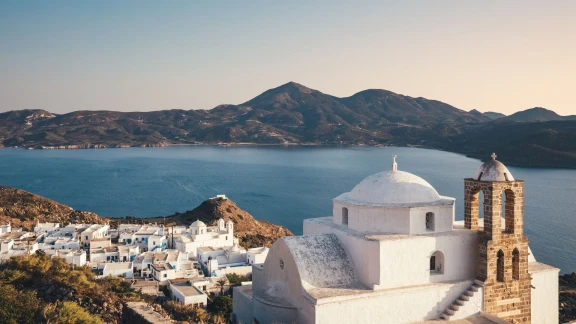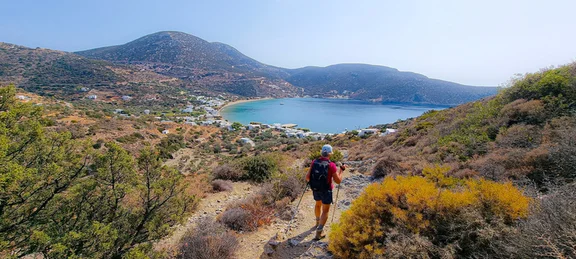


Naxos is the largest and the most generous of the Cyclades. Fertile valleys planted with olive and citrus trees, marble paths inherited from antiquity, mountain villages where time seems to have stopped between two seasons. It is an island made for slow walking, the kind that lets your gaze settle and your mind be carried by the beauty of simple things.
| In brief | The largest Cycladic island marries summits, thousand-year-old olive groves and deserted coves: a ground for gentle, varied walking. |
| Ideal for | Walkers who love their food, in search of mountain villages, Byzantine heritage and quiet swimming. |
| Best season | Spring (April to June) and early autumn (September to October). |
| Pace | At your own rhythm: walks of a few hours, never athletic. |
| Our trip | Naxos and Amorgos on foot, self-guided, 10 days |
Mount Zeus (Zas): the roof of the Cyclades
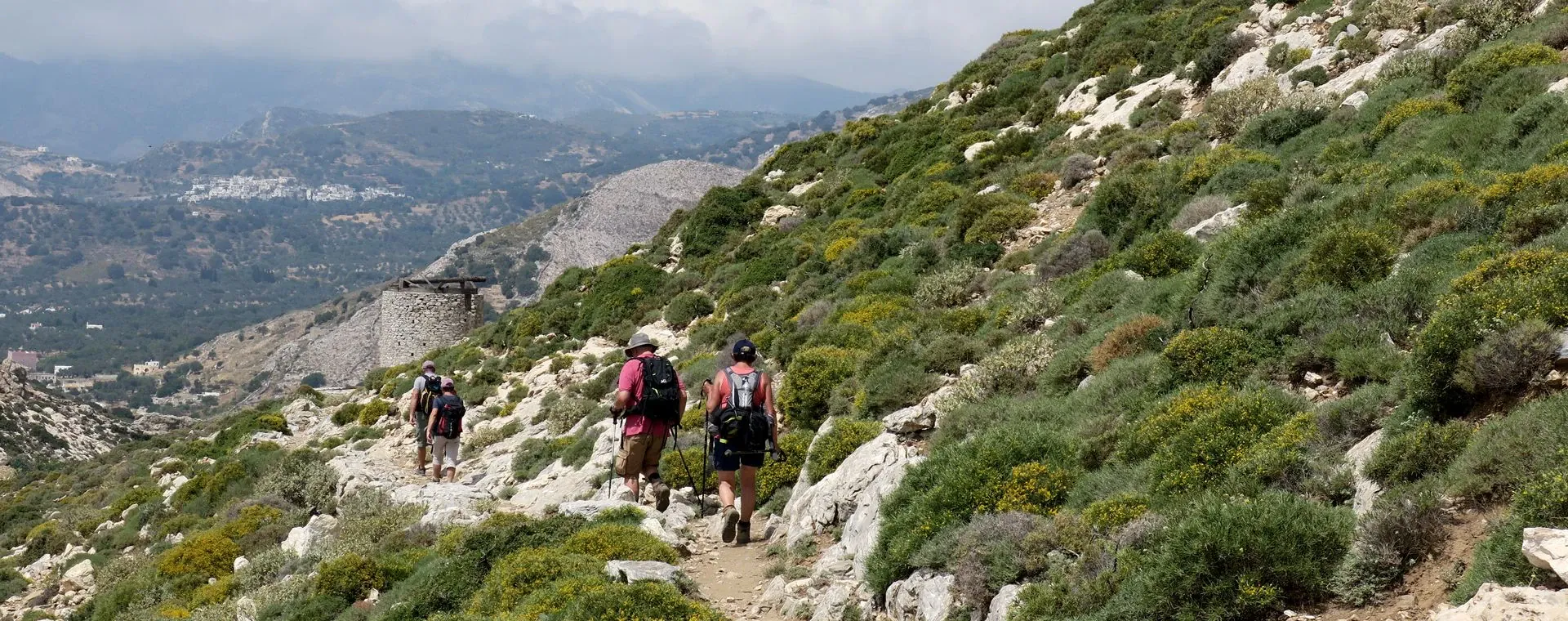
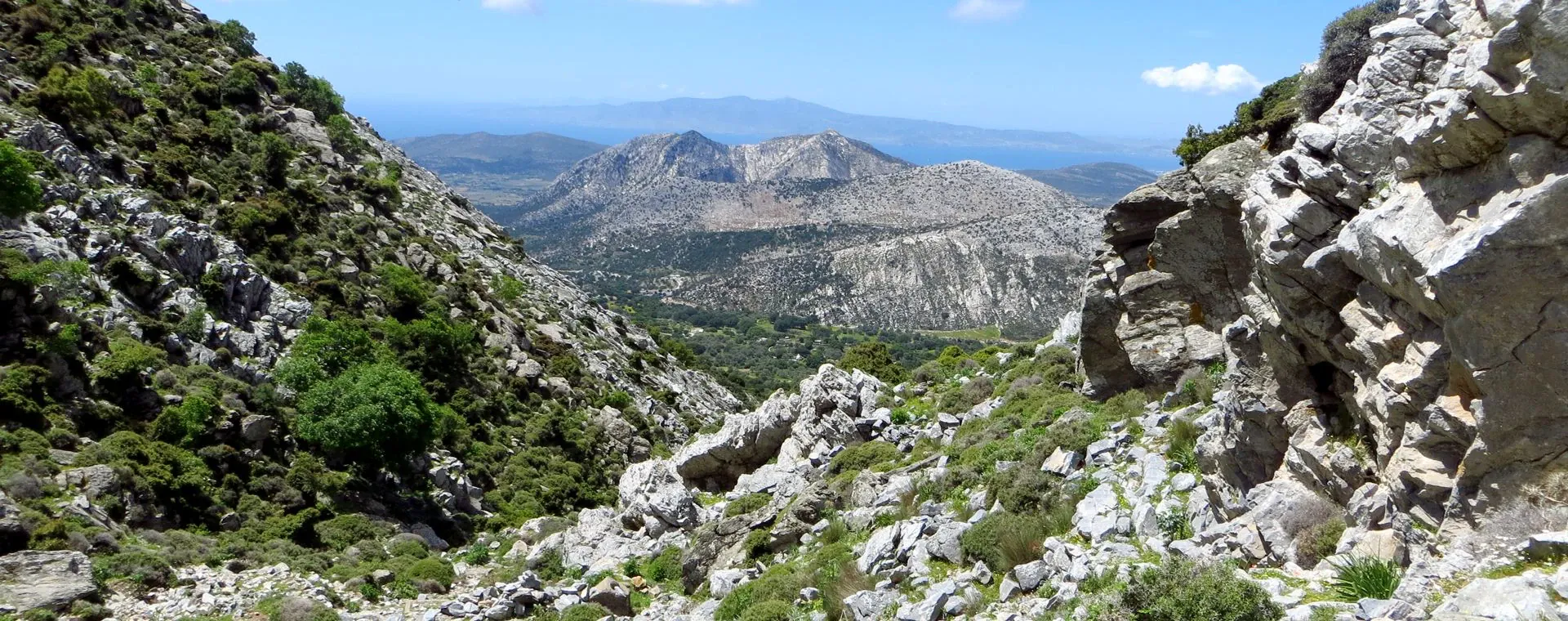
The highest point in the Cyclades bears the name of the king of the gods. At 1,004 metres, Mount Zas dominates the whole archipelago, and the path leading up to it from the village of Filoti is one of the finest walks on the island. You leave the shaded lanes of the village to set off on a track lined with centuries-old olive trees. The air smells of sage and wild thyme.
Halfway along, the path passes the cave of Zeus, a deep cavity where, according to mythology, the young god grew up hidden from the eyes of his father Cronos. The place has something solemn about it, with its damp walls and its mineral silence. You pause there, you imagine the ancient stories, then you take up the climb again.
The landscape transforms gradually. The olive trees give way to bare rock, the path becomes steeper, the horizon opens. As you rise, the neighbouring islands appear one by one: Paros first, then Ios, Amorgos, and on a clear day the distant silhouettes of Santorini and Mykonos. At the summit the panorama is circular. You stand above a whole archipelago, with that rare sense of taking in an entire blue and white world at a glance.
The walk takes around 3 hours there and back. It is not an athletic feat, it is a walk earned with a little patience and a great deal of pleasure. The return to Filoti is made in the golden light of the afternoon, and you arrive just in time to sit down on the village square, in the shade of the plane trees. That silhouette of Amorgos glimpsed in the distance is no accident: we link the two islands in our holiday Naxos and Amorgos on foot, self-guided, 10 days at your own pace between fertile valleys and wild paths.
The Tragea valley: Byzantine villages and olive groves
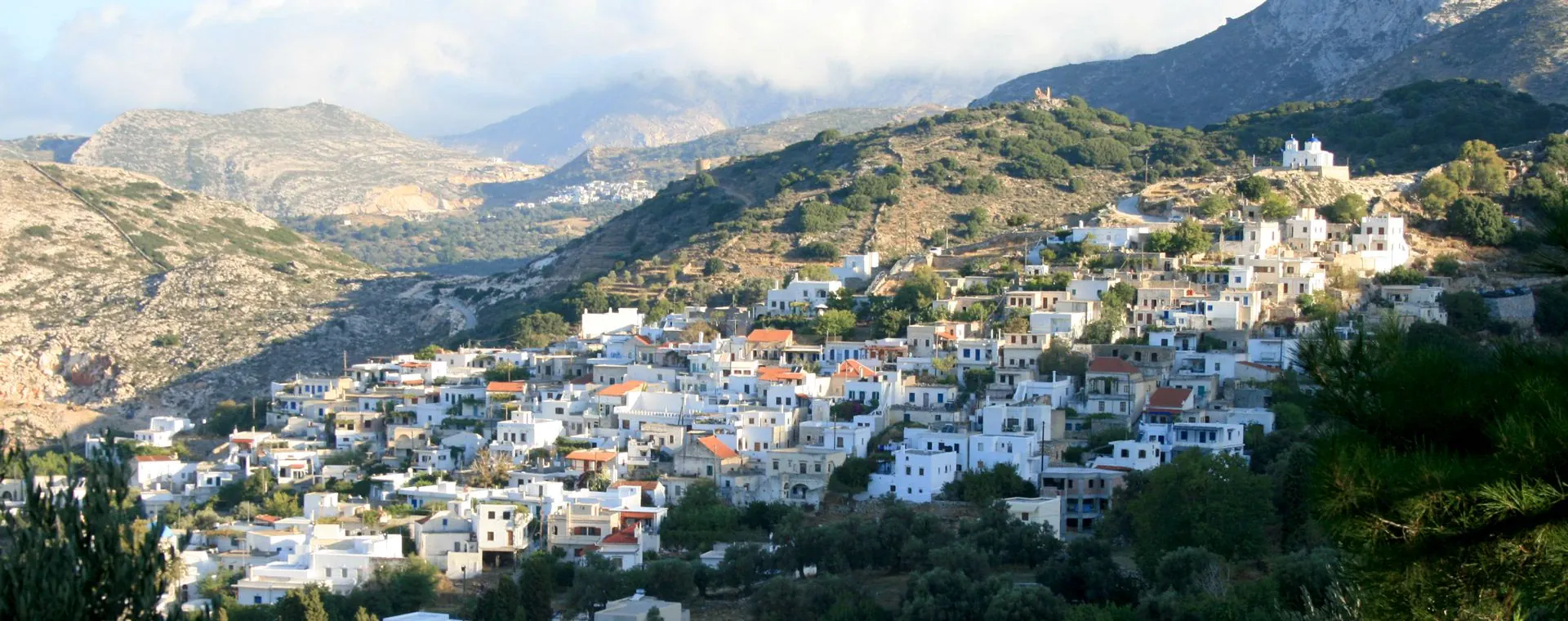
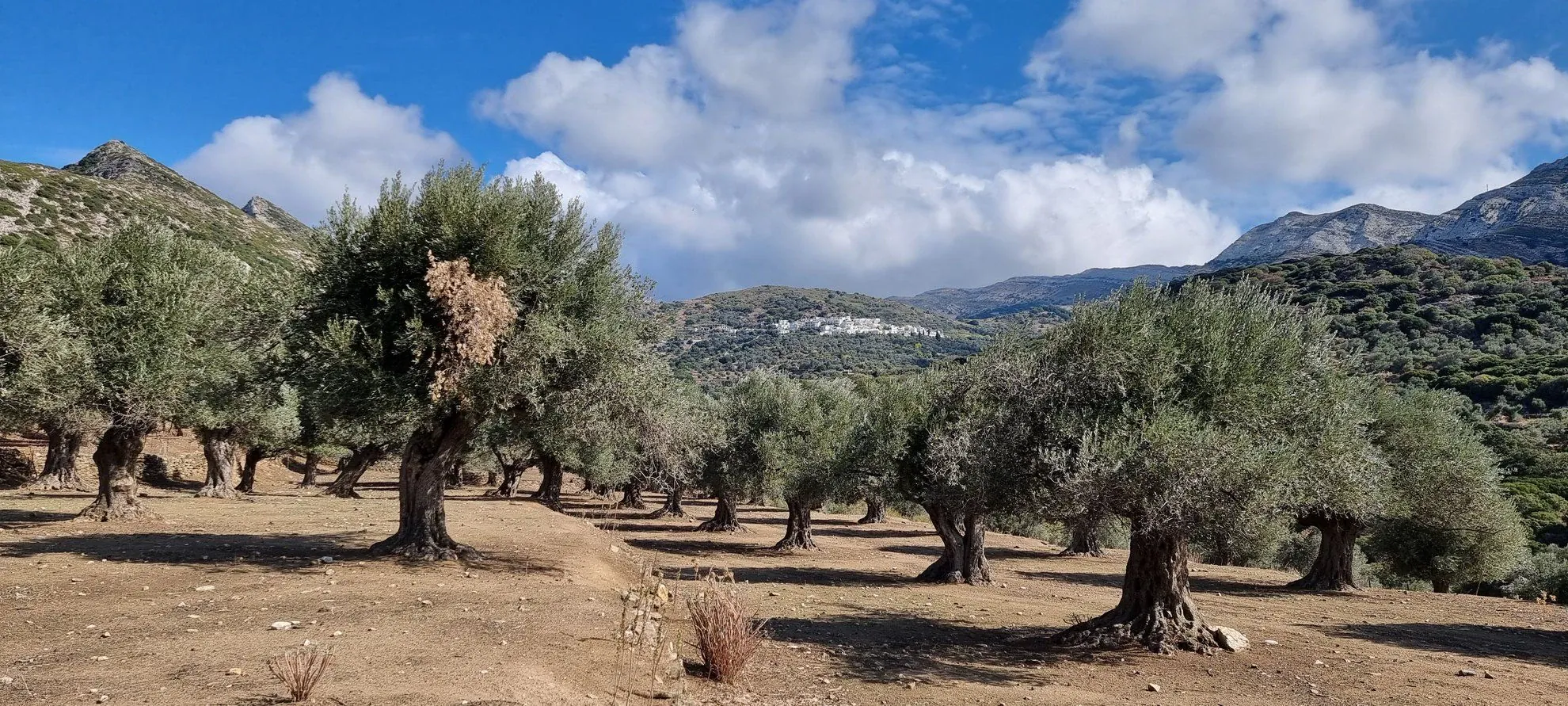
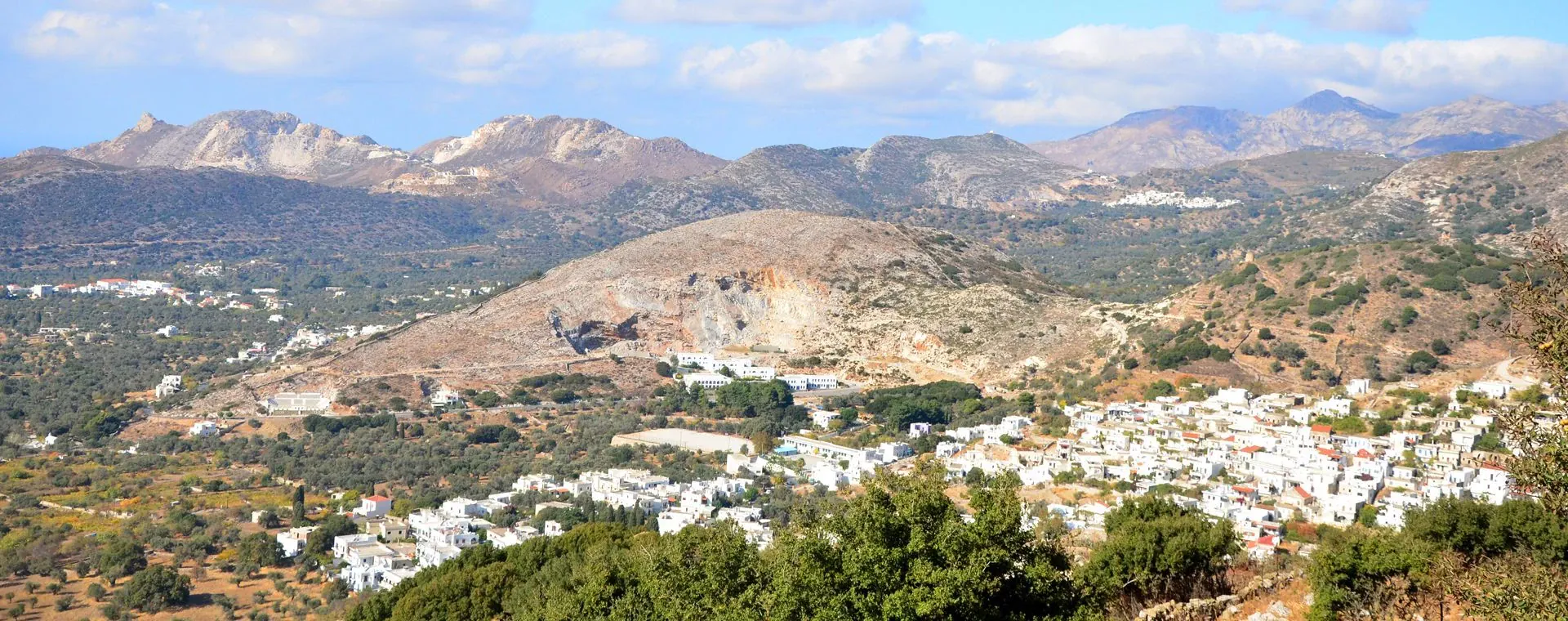
The heart of Naxos beats in the Tragea valley, a vast inland plain covered with an almost unbroken olive grove said to be a thousand years old. To walk in this valley is to pass from one village to the next along shaded paths, to come upon Byzantine chapels hidden beneath the trees, and to discover a heritage few visitors suspect.
Halki, the island’s former capital, keeps handsome Venetian houses with carved coats of arms and a distillery of kitron, the citrus liqueur that is the pride of Naxos. You taste this golden drink in a vaulted room with the coolness of another age, in three versions distinguished by their colour: the green, the sweetest, the white, rounder, and the yellow, the driest. Further on, Apiranthos alone is worth the detour. Nicknamed the “marble village”, this mountain town unfolds lanes entirely paved with white marble, small museums (geology, archaeology, folklore) and cafés where the old men play tavli over a Greek coffee.
Between the two, Filoti is the island’s largest village, set against the slopes of Mount Zas. Its central square, shaded by centuries-old plane trees, invites you to stop. You settle there for a simple lunch: Naxian tomato salad, fresh cheese, barley bread. Along the paths linking these villages, the surprises multiply. Here, a 7th-century Byzantine church whose frescoes defy the centuries. There, a Venetian tower overrun with fig trees. The Tragea valley is an open-air museum, and the path is its finest guide.
From Apiranthos to Moutsouna: the old emery road
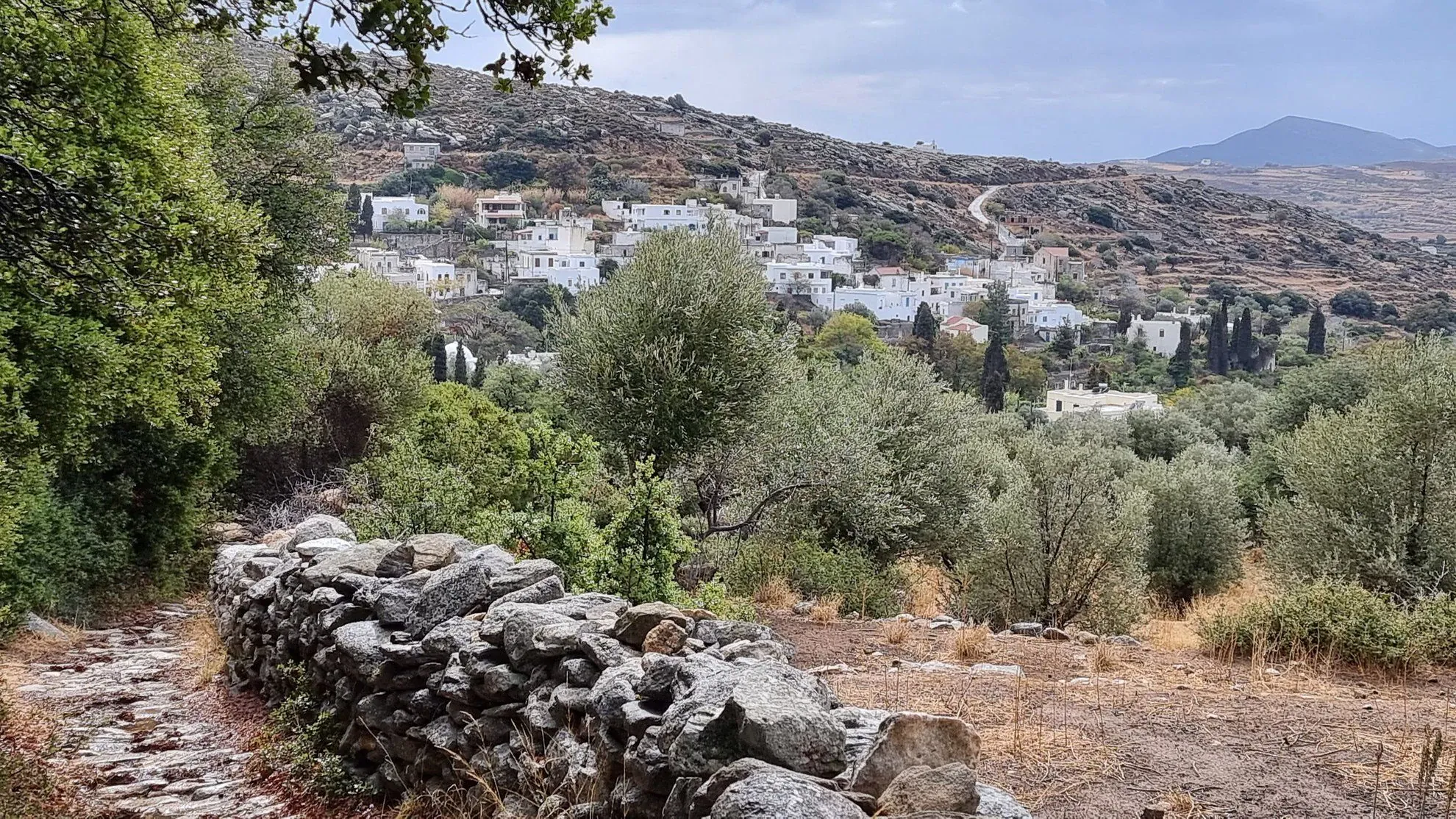

Naxos holds a geological treasure few islands can claim: emery, that formidably hard rock used since antiquity to polish marble and sharpen blades. The path linking Apiranthos to the small port of Moutsouna, on the east coast, is the old miners' road. For centuries, men brought this precious ore down on muleback, from the mountain quarries to the loading quays.
The walk begins in the marble lanes of Apiranthos and descends gradually towards the sea. The landscape is transformed as you go. You leave the cultivated terraces of the interior to enter a more austere world, made of grey rock and low maquis swept by the wind. Then the sea appears, deep blue, framed by sheer cliffs.
At Moutsouna, the emery loading quay is still there, with its rusted rails and abandoned hoppers. This industrial relic, set at the edge of translucent water, has something poignant about it. The village itself is tiny: a few fishermen’s houses, a taverna, silence. You eat a grilled fish of the day contemplating the waves, before setting off again. It is a walk that tells a story, that of men’s labour in a landscape of fierce beauty.
The tower of Chimarros: marble sentinel

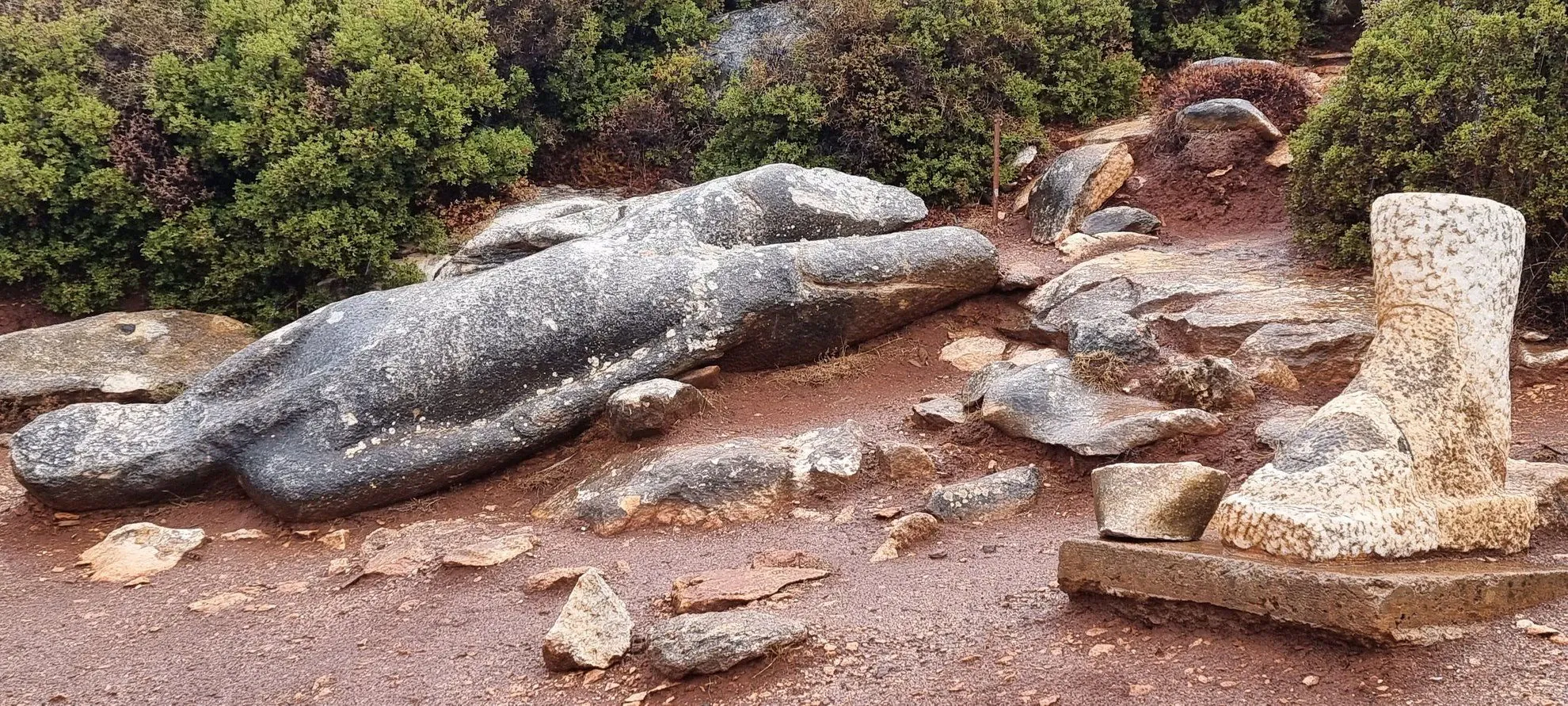
In the countryside south of Filoti, a cylindrical tower stands alone in the middle of the fields. The tower of Chimarros, built in the 4th century BC, is one of the best-preserved Hellenistic monuments in the Cyclades. Constructed entirely of white marble blocks assembled without mortar, it still reaches some fifteen metres after 2,300 years.
The path leading to it crosses an open landscape of gentle hills, scattered with holm oaks and dry-stone walls. You walk in a silence broken only by the distant tinkle of a goat bell. The tower appears suddenly, massive and elegant at once, with that golden patina the sun gives to Naxian marble. Its exact function is still debated: watchtower, fortified granary, landmark for navigators?
You can combine this walk with the ascent of Mount Zas to fill a whole day. The morning at altitude, the afternoon in the fields: two faces of Naxos for the same feeling of fullness.
Southern coastal paths: deserted beaches

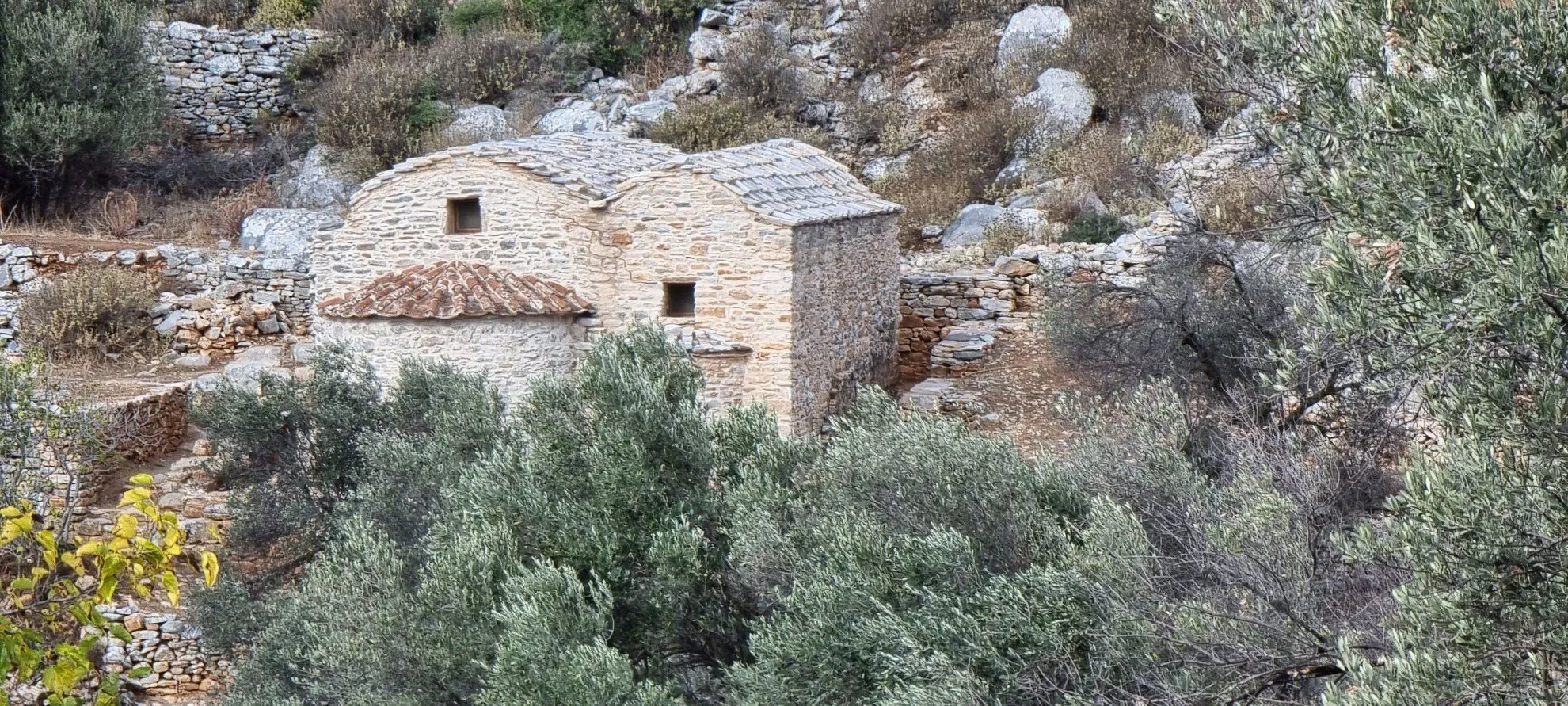
The south of Naxos is a world apart. Far from the developed beaches of the west coast, the Alyko peninsula offers a wild landscape where a forest of centuries-old cedars runs down to the sand. Discreet paths wind between the trees and reach secret coves, away from everything. The remains of a vast hotel never completed, today taken over by street artists from around the world, add a strange poetry to the place.
Further south still, towards Kalantos, the coast becomes steeper, the beaches more secret. You reach them by shepherds' paths zigzagging between hills covered with maquis. The reward, at the end of the path, is always the same: a cove of sand or pebbles, crystalline water, and that rare sensation of having a shore to yourself. You spread your towel, you dive in, you dry in the sun. Happiness sometimes lies in so little.
These coastal walks demand no particular effort or special preparation. Just a swimsuit in the bag, a bottle of cool water, and the wish to let curiosity be your guide. And if you are looking for things to fill the days between two walks, from ancient sites to the old town of Chora, we have gathered our ideas in what to do in Naxos.
Flavours of Naxos
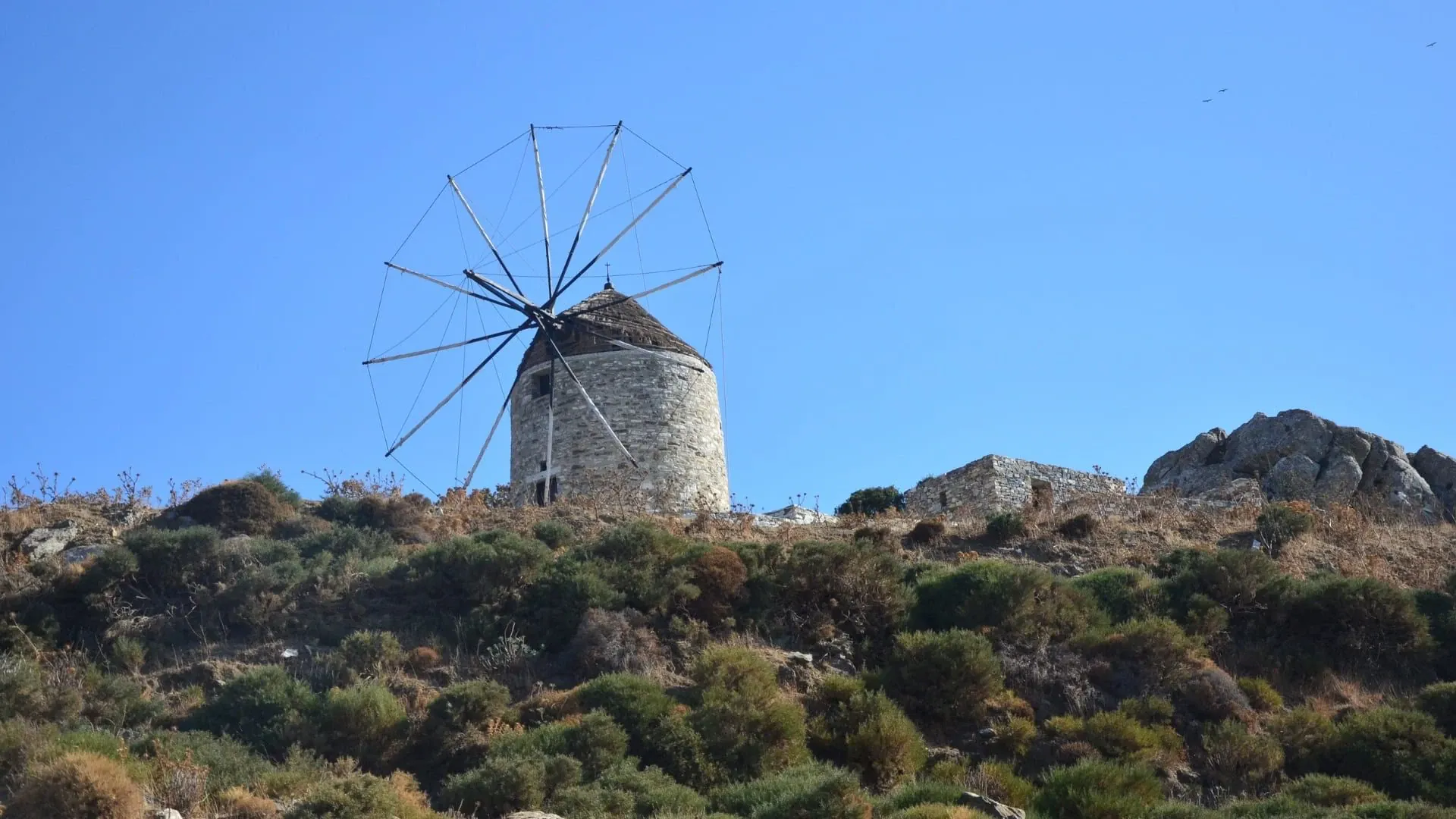
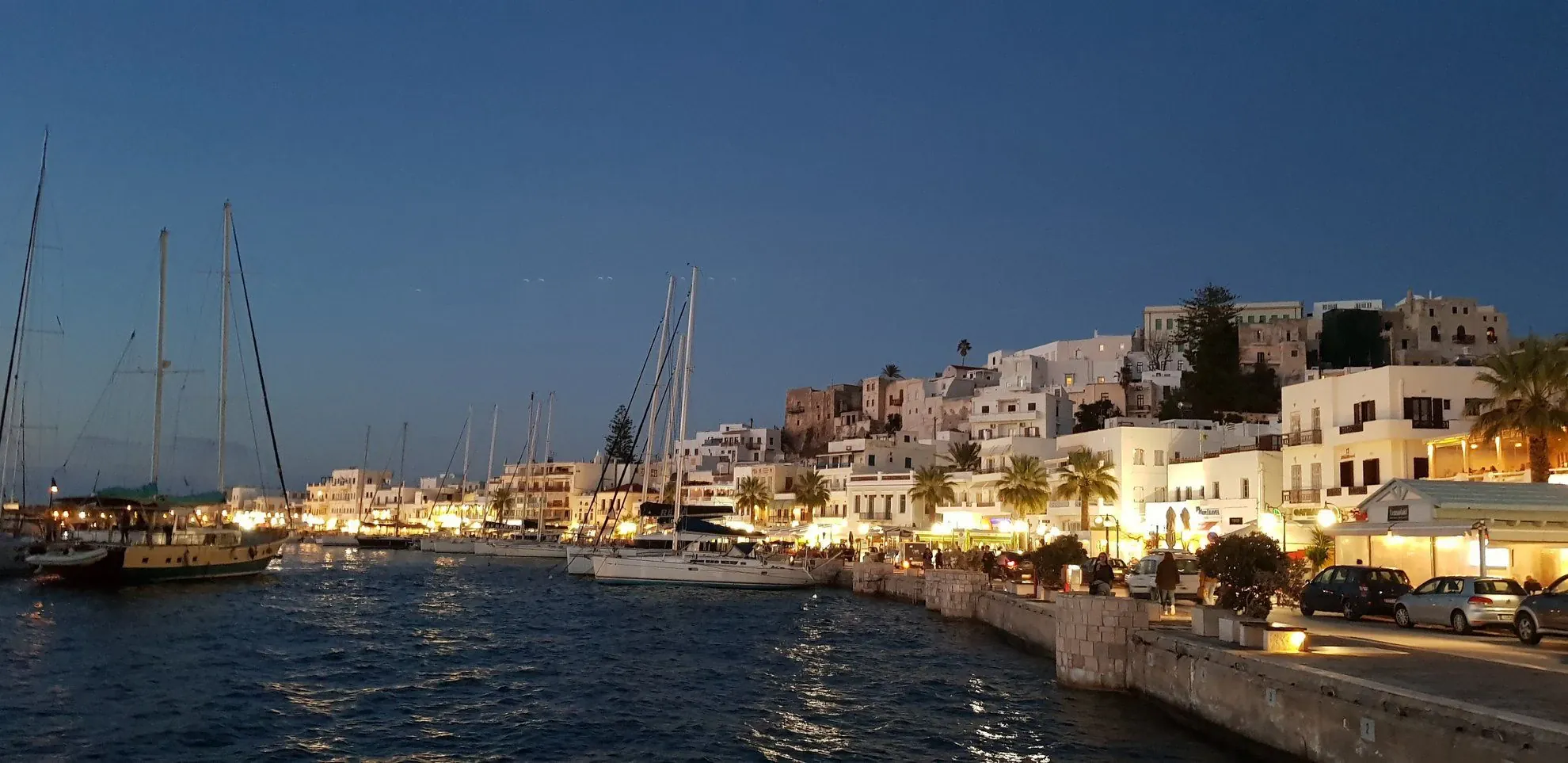
To walk on Naxos is also to eat on Naxos, and the island offers at table a generosity that mirrors that of its landscapes. The Naxos potato enjoys a reputation reaching well beyond the archipelago: grown in the fertile valleys of the interior, it is so flavourful that Athens restaurants list it on their menus as a mark of quality.
Kitron, that unique liqueur drawn from the citron (a citrus close to the lemon), is produced nowhere else in Greece. The Vallindras distillery, in Halki, has kept up a family craft since 1896. You taste three versions of this golden elixir there, and leave with a bottle at the bottom of your bag, a fragrant souvenir of a pause between two paths.
Naxos graviera, a hard cheese aged in mountain cellars, accompanies every meal. Shaved over a salad or served in thick slices drizzled with local honey, it embodies the Naxian terroir at its most authentic. And then there is thyme honey, wild capers, raki distilled in the villages, cold-pressed olive oil. On Naxos, the paths always lead to a table, and the table always leads back to the paths.
When to walk on Naxos
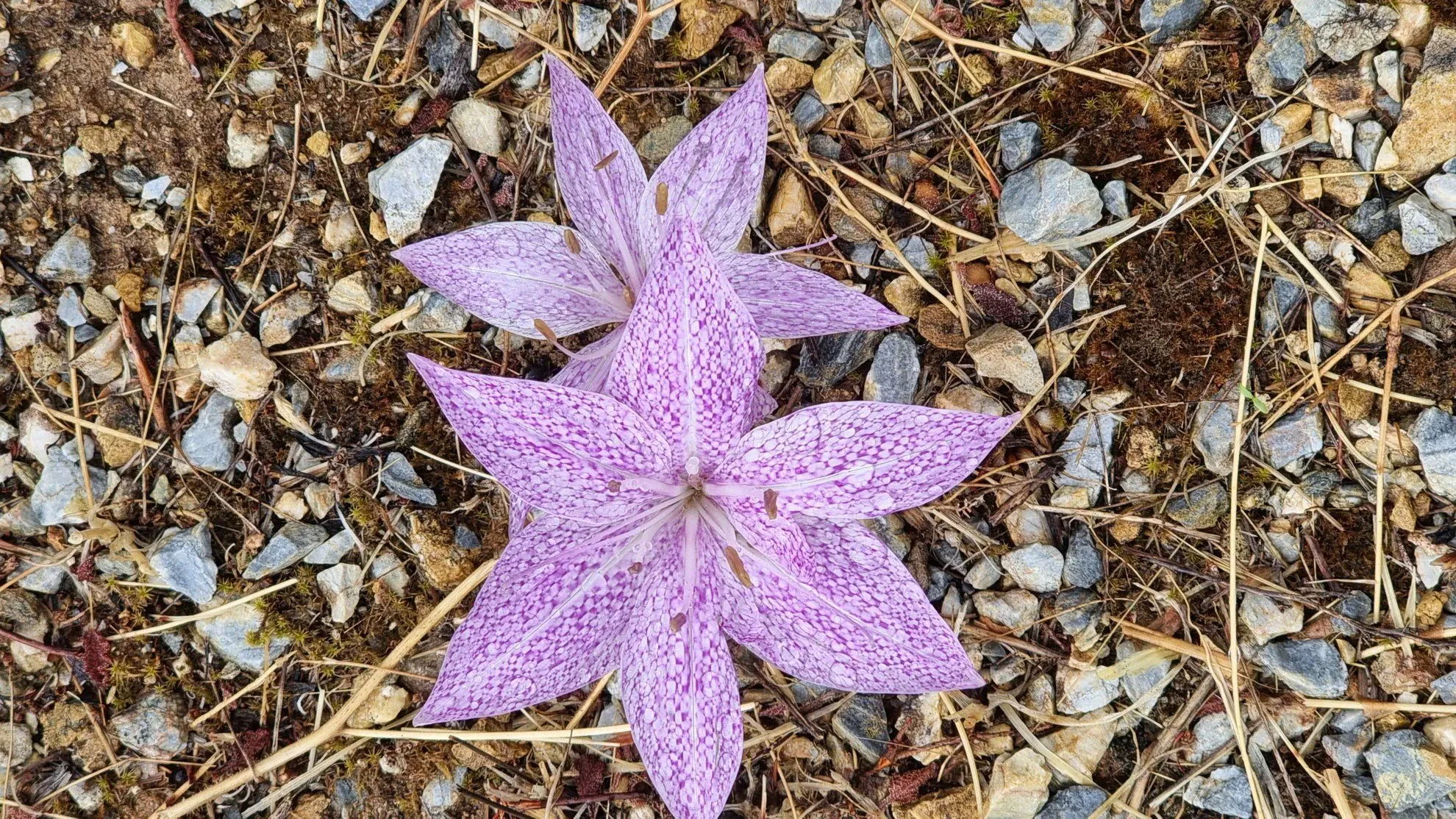
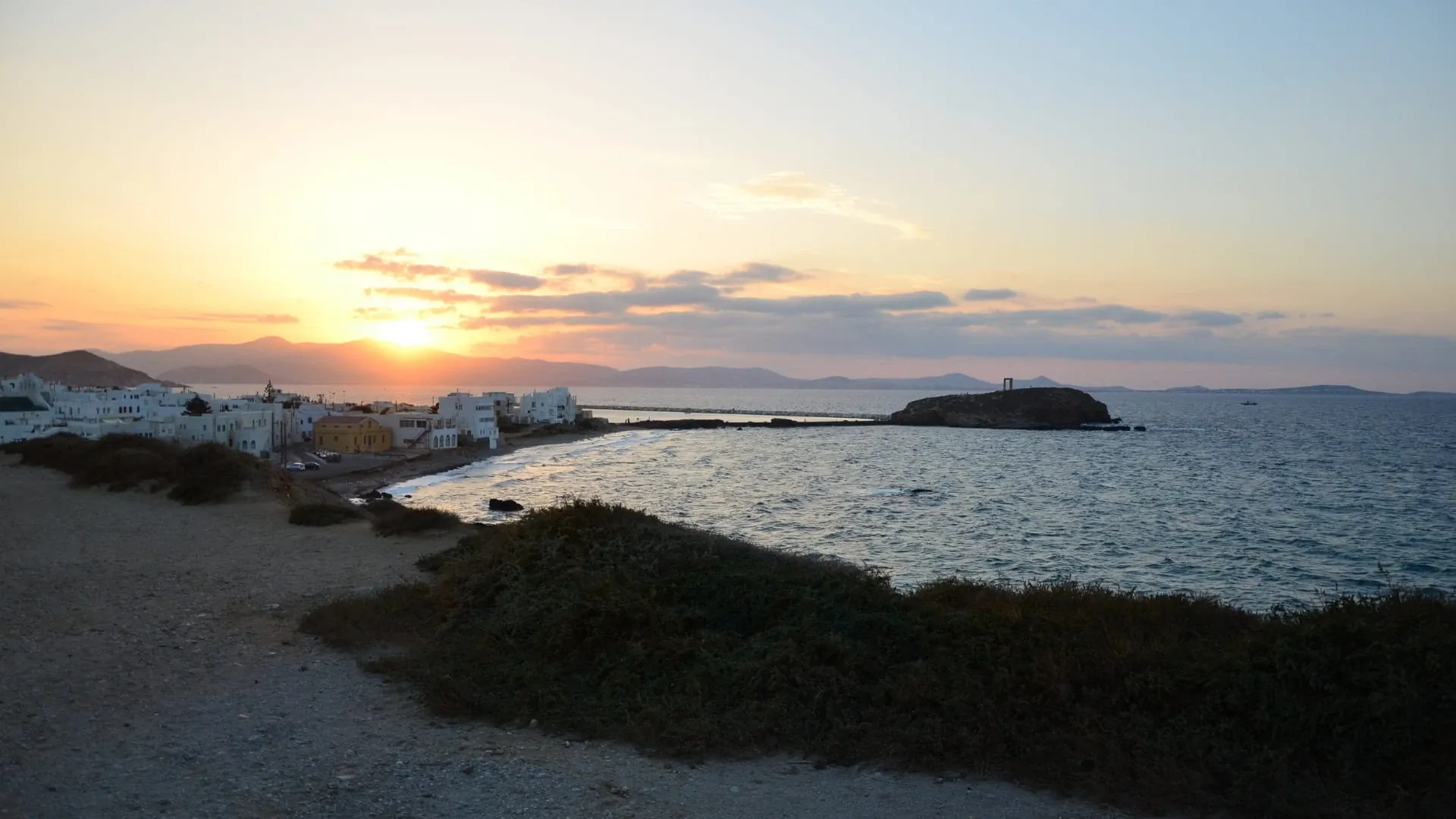
The best seasons to walk Naxos are spring (April to June) and early autumn (September to October). In spring the island is covered with wildflowers, temperatures are mild, and the paths are quiet. It is the season when the Tragea valley is at its most fragrant, when the colours are most vivid, when the light has that particular quality that delights photographers.
In September and October the sea is still warm for swimming, the days stay long and bright, and the island recovers its serenity after the summer. It is also the season of the grape harvest and the first olive picking, when the villages return to their authentic rhythm. Summer (July and August) is hotter and windier, with the meltemi sometimes blowing hard, but morning walks and coastal paths remain perfectly practicable.
Browse all our trips in the Cyclades and our favourite trails in Greece to compose your next escape.
Frequently asked questions
Do you need to be a strong walker to discover Naxos on foot?
No, and that is the whole appeal of the island. The itineraries described here are walked in a few hours, on ancient paths, at your own pace. Mount Zas asks for a little breath in its upper section, but most of the walks — the Tragea valley, the southern coastal paths — stay gentle and accessible. You walk for the pleasure of the landscape and the pause at the taverna, not for performance.
Is it better to walk Naxos self-guided or with a leader?
Naxos lends itself ideally to self-guided walking. Its ancient paths are well waymarked and the distances stay moderate, so route-finding poses no problem from one village to the next. Self-guided, you set off at your own pace with detailed route notes, the GPS tracks and accommodation booked in advance, your luggage transferred from one stage to the next. That is the formula of our Naxos and Amorgos self-guided holiday, 10 days to link the two islands as you please. The island’s careful waymarking and the comfort of the route notes make it a fine gateway into the Cyclades, even for a first walking escape.
How do you get to Naxos?
The simplest way is the boat from Piraeus, the port of Athens. Allow around 3 to 4 hours on a fast ferry, 5 to 6 hours on a large Blue Star type vessel, more comfortable and often cheaper. Naxos also has a small airport linked to Athens by a flight of some forty minutes. The island is very well connected to the rest of the Cyclades, which makes island-to-island combinations easy.
Where can I find a map or a walking route for Naxos?
Two Greek publishers are the reference for walking on the island. The Anavasi Topo map no. 10.28 (1:40,000) covers the whole of Naxos, with an enlargement at 1:10,000 on the Tragea valley and its Byzantine chapels. The Terrain map no. 311 (1:40,000, multilingual) maps the island’s fifteen waymarked paths, nearly 180 km, with distances and walking times detailed on the reverse. Both are found in travel bookshops and online, and the Wikiloc community shares many tracks for scouting routes. If you would rather prepare nothing, our self-guided holidays hand you step-by-step route notes together with the GPS tracks, everything you need to follow each path with an easy mind.
Naxos or Paros for walking?
The two neighbouring islands resemble one another in their gentleness, but Naxos offers more pronounced relief, mountain villages and an inland olive grove that Paros does not have. Paros appeals with its more fashionable villages and its lively harbours. We have set out the nuances between the two in Naxos or Paros, enough to decide according to your travelling mood.
Which Cycladic island should you choose if you love walking?
It all depends on the atmosphere you are after: summits and heritage on Naxos, spectacular paths on Amorgos, gentler seaside elsewhere. To find your bearings in the archipelago and choose according to your wishes, browse our guide which Cycladic island to choose.
Can you walk on Naxos in summer?
Yes, provided you adapt your timing. In July and August it is better to set off early in the morning or in late afternoon, and to favour coastal paths that end in a swim. The mountain paths are superb but without shade, and the meltemi can blow hard. Spring and early autumn remain the most pleasant seasons to enjoy the island fully.
Your question is not on this list?
Write to us, and we will reply to you personally by email.
Continue reading
- What to do in Naxos? The gentlest and most delicious of the Cyclades
- Which Cyclades island to choose for the trip you have in mind?
- Naxos or Paros: which Cycladic island suits the trip you want?
- Hiking in Greece: the best trails island by island
Article written by
Maria Papadopoulou (Μαρία Παπαδοπούλου)
Editorial lead
I hike, and Greece is the place I keep coming back to. My initial studies (a Master’s in Marketing and a degree in Applied Foreign Languages) taught me how to build an editorial project, and the trails taught me the… Read more