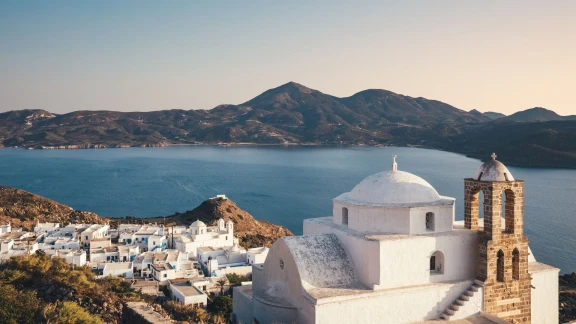


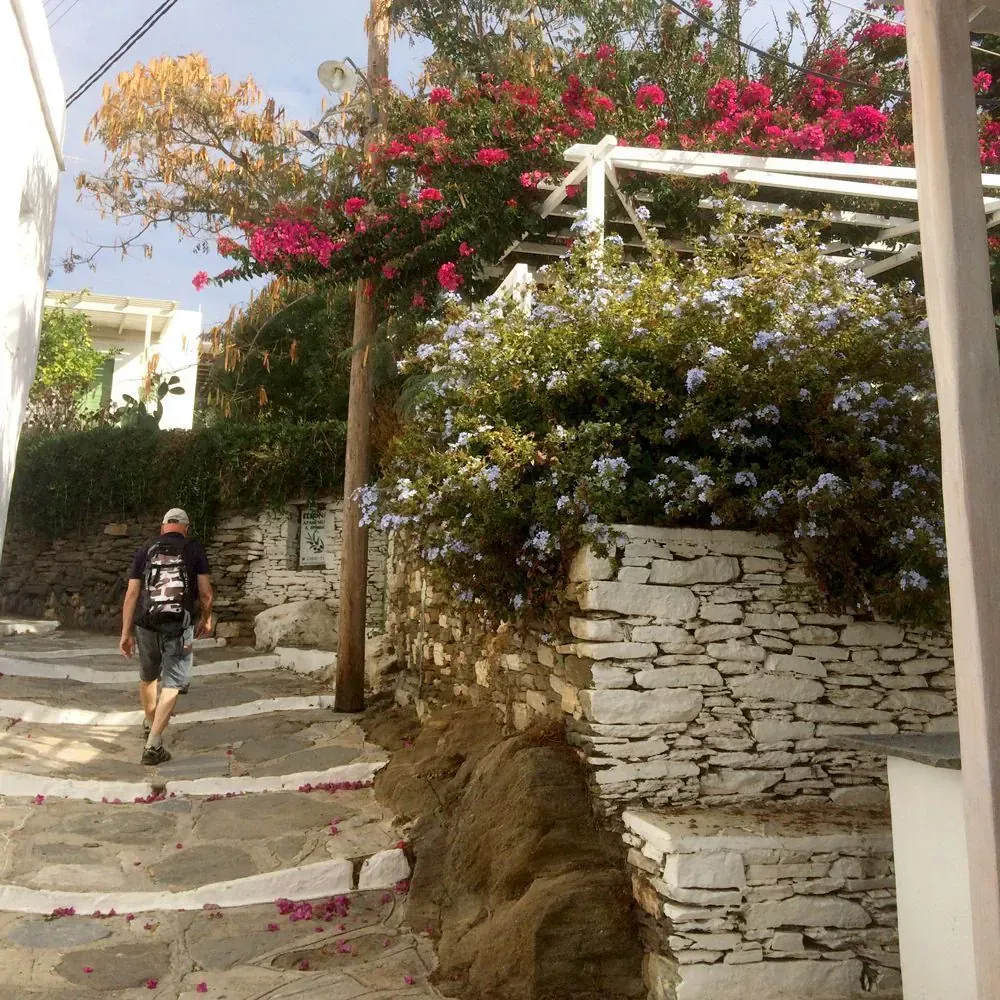
On Sifnos, walking and sitting down to eat are two faces of the same pleasure: you pass from one to the other without ever forcing the pace. A network of kalderimia, those paved paths inherited from the time when people walked from one village to the next, from a chapel to a mill, from a potter to a shepherd, still links the white hamlets today. And since the island is the gastronomic capital of the Cyclades, every walk happily ends at a taverna. If you are still drawing up your itinerary through the archipelago, our guide to which Cycladic island to choose places Sifnos among its neighbours.
| In brief | A network of waymarked paths some hundred kilometres long links the white villages, the chapels and the tavernas of the gastronomic capital of the Cyclades. |
| Ideal for | Anyone who likes to combine gentle walking with a good table, at their own pace. |
| Best season | Spring (May, June) and early autumn (September). |
| Pace | Gentle: paved kalderimia, reasonable distances, taverna stops. |
| Our trip | Cycladic enchantment: Serifos, Sifnos and Milos, self-guided. |
From Apollonia to Kastro: the path of panoramas
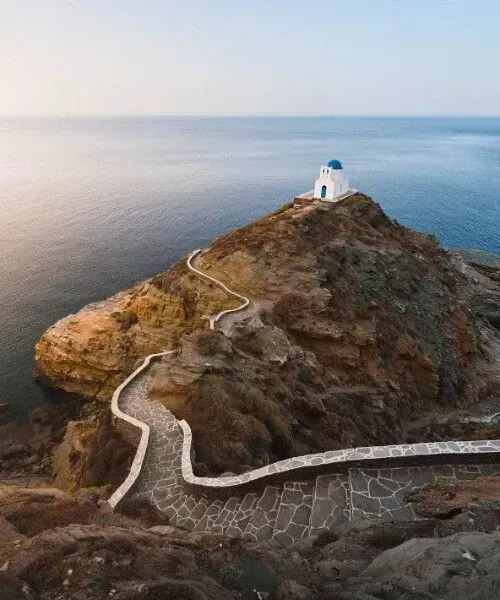
The path linking Apollonia, the small capital, to the medieval village of Kastro is one of the finest on the island. You leave the busy lanes to set off on a kalderimi lined with dry-stone walls. White chapels punctuate the walk, each with its icon and its bunch of dried flowers. The landscape opens gradually onto the Aegean, and Kastro appears, clinging to its cliff like a swallow’s nest. This fortified village, ringed by houses that themselves form a rampart, offers from its terraces a panorama of quiet beauty. Kastro in fact takes pride of place in our selection of the most beautiful villages in the Cyclades, alongside other perched settlements of the archipelago. You sit down there for a Greek coffee, facing the blue.
A legend says that Sifnos has 365 chapels and churches, one for each day of the year. All are maintained by the inhabitants, who restore them for the patron saints' festivals. Along the paths, these small immaculate buildings serve as reassuring landmarks: they give the walk its rhythm and invite a contemplative pause, where the sacred and the everyday are one and the same.
Artemonas to Cheronissos: crossing the island

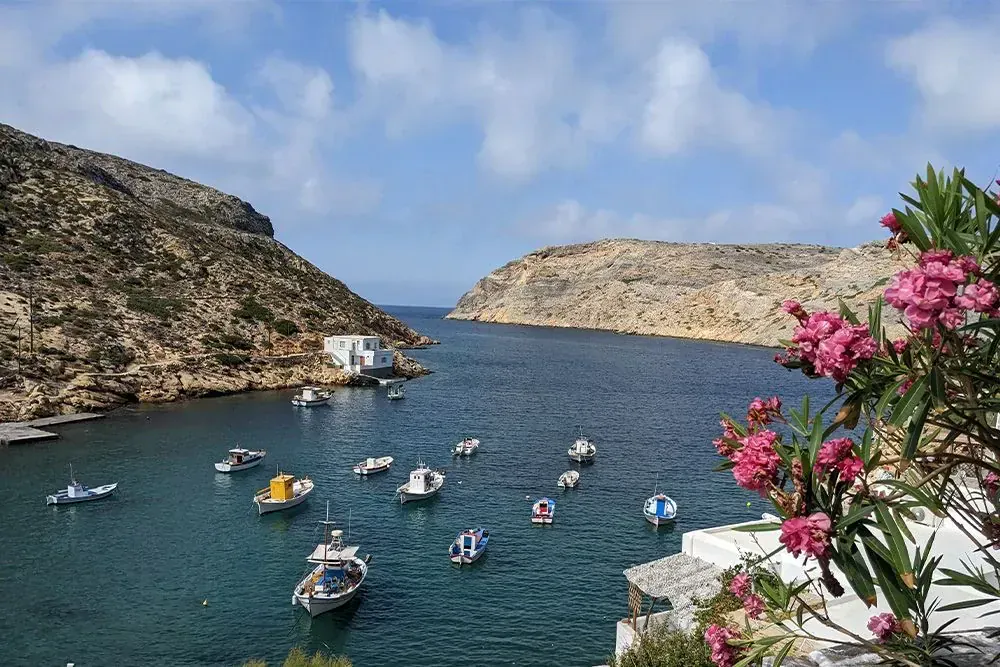
Crossing Sifnos from the centre to its northern tip means passing in a few hours from terraced hillsides to wild valleys planted with junipers, before dropping back down to the sea. The path linking Artemonas to the small port of Cheronissos crosses the heart of the island, where sunflowers and caper plants grow between the low walls. At Cheronissos, the last pottery workshops keep alive a craft thousands of years old. You arrive with just the right appetite, and the harbour taverna, feet in the sand, serves a grilled fish worth the detour on its own.
Pottery is inseparable from Sifnian identity. The island’s clay, abundant and of good quality, supported generations of artisans from antiquity onwards. Even today, a few workshops open to visitors offer the chance to try the wheel and shape your own piece. These bowls and jars are not simple souvenirs: revithada and mastelo are cooked in them, and you find the same forms in the archaeological museum of Kastro.
The bay of Vathy: a gourmet walk
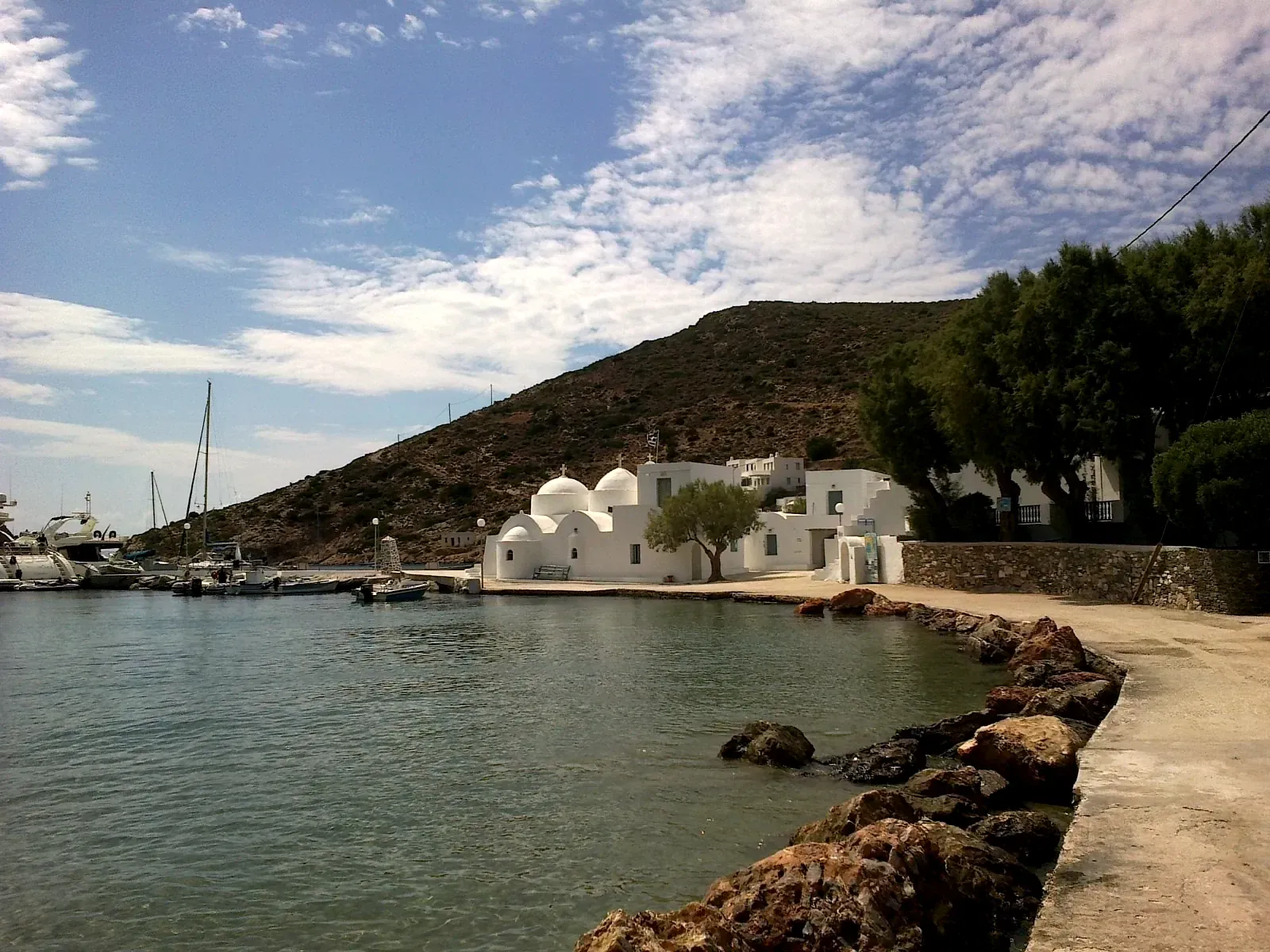
Vathy is a round bay, almost closed, sheltered from the winds like a well-kept secret. You reach it by a coastal path that follows deserted coves before emerging at this miniature village. A few houses, a monastery dedicated to the Archangel (the Taxiarchis), and tavernas whose reputation reaches well beyond the island’s shores. This is where you taste the best of Sifnian cooking in a setting of disarming simplicity: feet in the sand, the sea 3 m away, time abolished.
Profitis Ilias: the belvedere of Sifnos
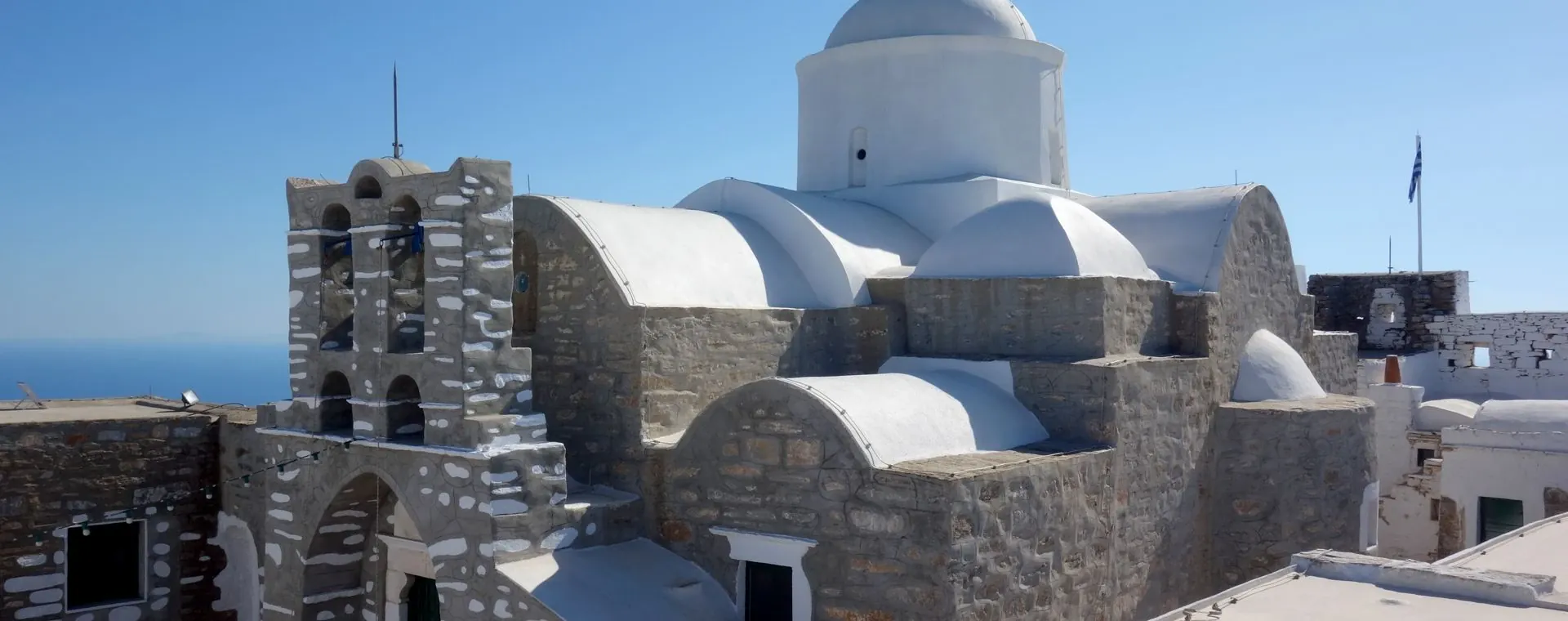
The island’s highest point is earned by a gradual walk through a landscape of gentle hills. At the summit, a whitewashed chapel and a circular panorama over the archipelago: Milos to the south, Serifos to the north, Paros to the east, and all around the blue immensity of the Aegean. The climb is steady, never hard, and the silence up there invites contemplation. You understand why the Greeks placed their prophets on the heights. From up there Serifos looks close at hand: its more mineral silhouette, almost pure Cycladic, contrasts with the cultivated gentleness of Sifnos. If you are hesitating between the two, our comparison Sifnos or Serifos will help you choose, or link them together.
From Faros to Chrysopigi: between chapels and coves
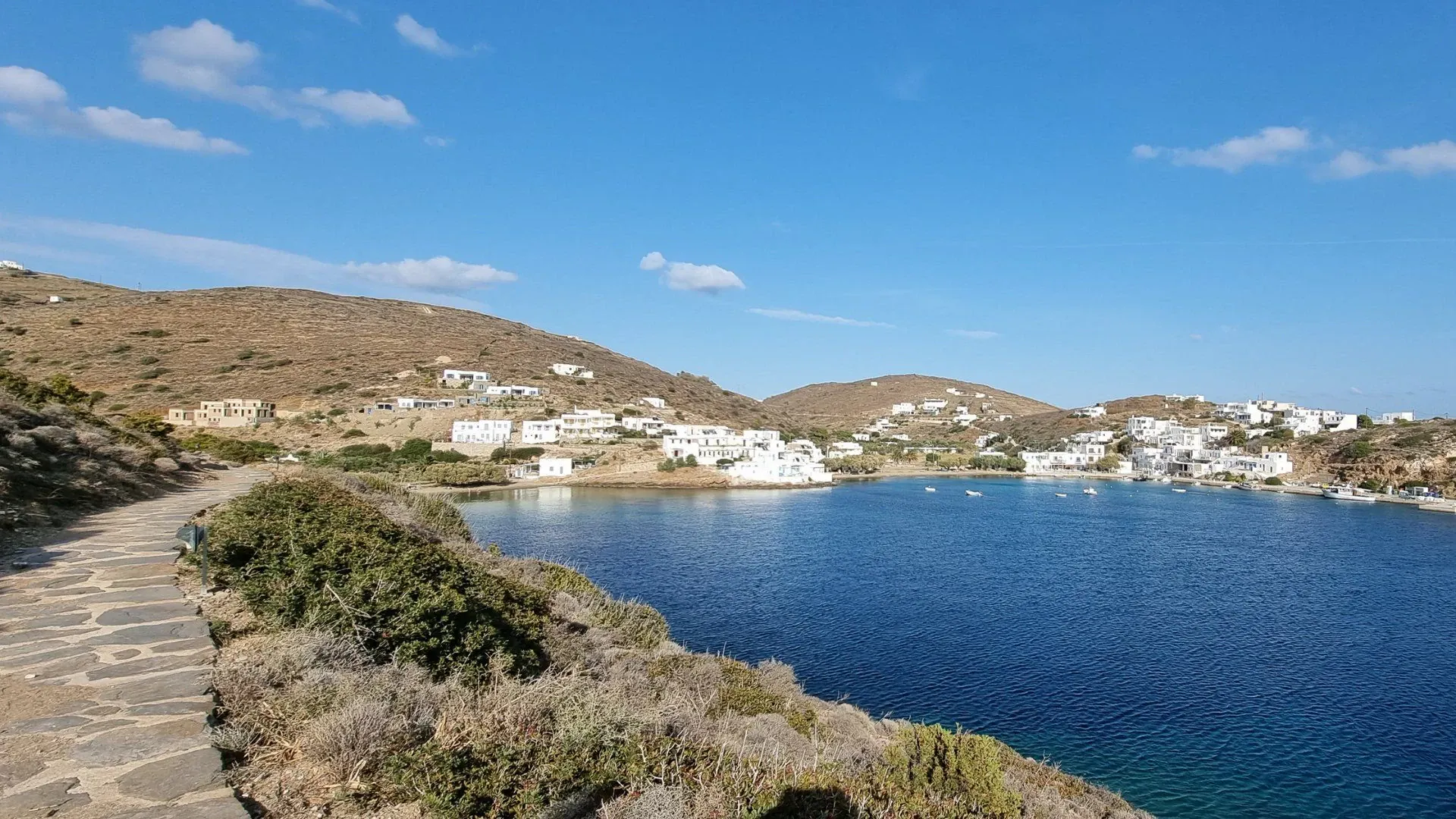
The south coast of Sifnos holds a walk of great gentleness. From the small port of Faros, the path follows the rocky shore, passing from one cove to the next. You swim at Glyfos, dry in the sun on the smooth rocks, then set off again towards the point where the monastery of Chrysopigi stands. Set on its promontory linked to the land by a narrow bridge, it is the most famous image of Sifnos, and one of the finest in the Cyclades. The late-afternoon light there is sumptuous.
Sifnos at the table
You cannot separate the paths of Sifnos from its cooking. The island is famous for revithada, a chickpea stew cooked all night in an earthenware pot, once carried to the village oven on Saturday evening to be eaten on Sunday. Mastelo, lamb slow-cooked in red wine in a ceramic vessel, is the other great speciality of the Sifnian table. The clay soil that made the reputation of the island’s potters also shaped its gastronomy: here, you cook and serve in the same earth. Add manoura aged in wine lees, capers picked off the low walls, wild thyme that scents the local honey, and you understand why Sifnos is a journey as much for the palate as for the eyes.
When to go
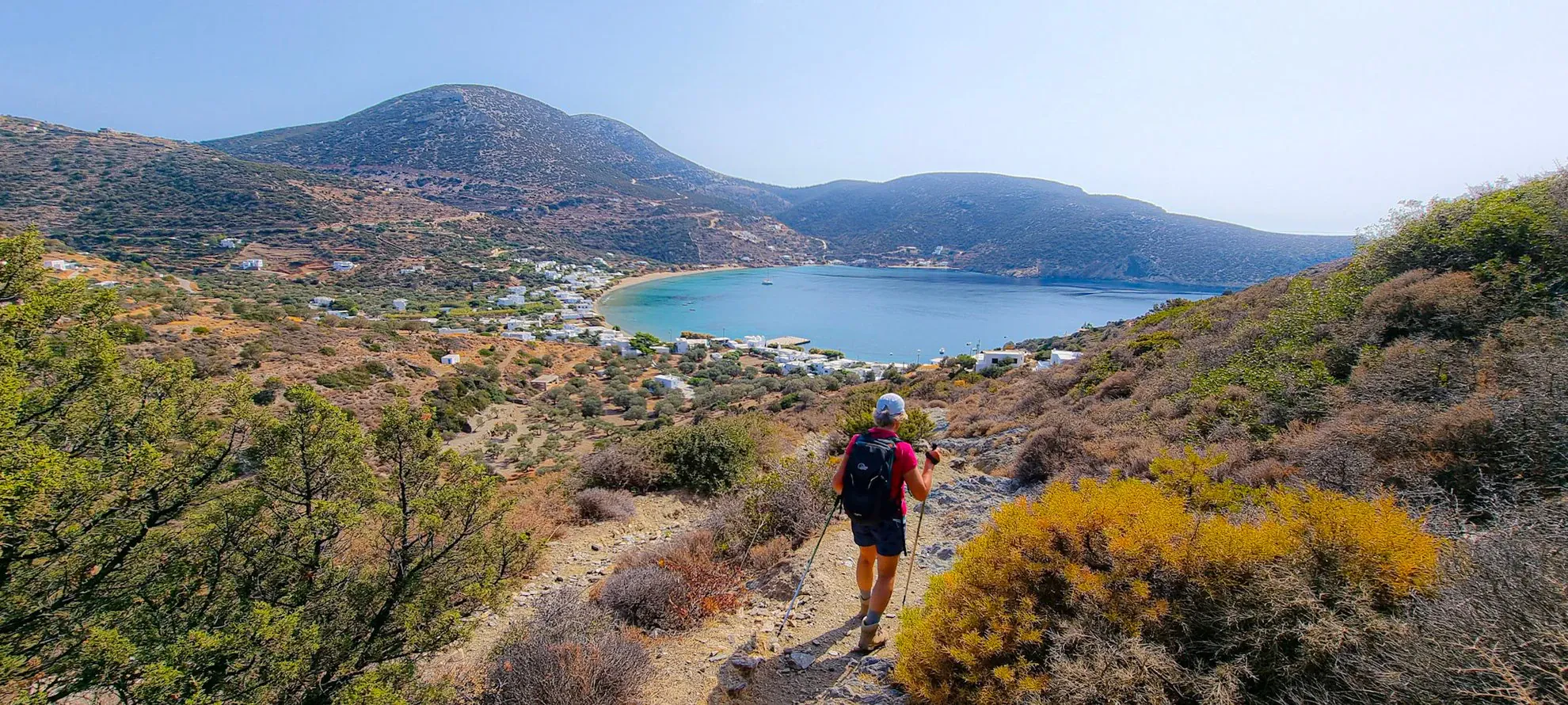
Sifnos is ideally savoured in spring and early autumn, when the light is golden and the heat kind. May, June and September offer the best conditions for walking: paths in flower in spring, a sea still warm in September, and that ease of living that gives the Cyclades their charm out of season.
In September, do not miss the Sifnos gastronomy festival (Nikolaos Tselementes), which celebrates the island’s culinary tradition through tastings, cookery workshops and competitions between local chefs. It is the ideal moment to taste the diversity of Sifnian recipes in a village-festival atmosphere.
How to get to Sifnos
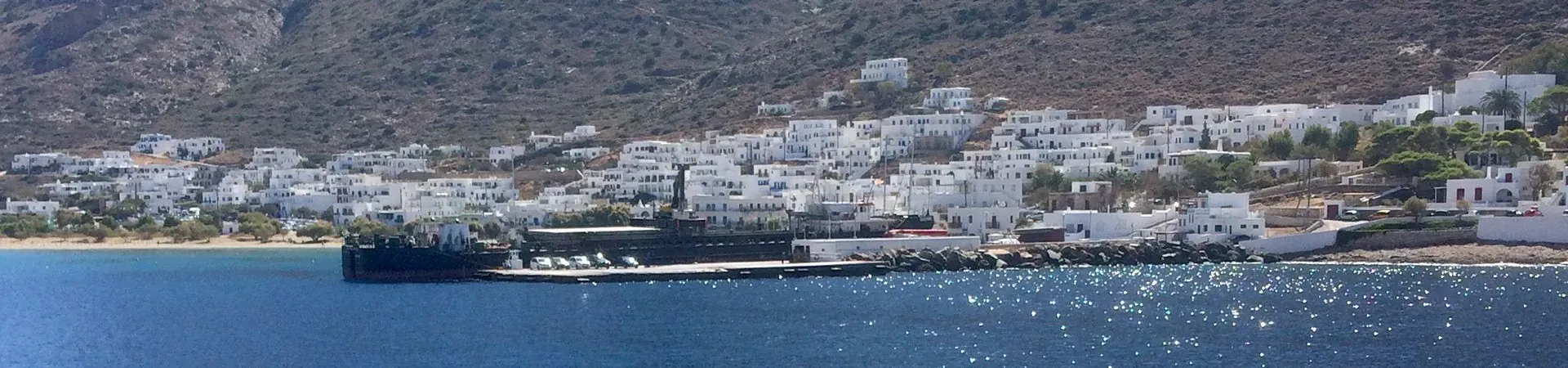
Sifnos is reachable by ferry from Piraeus, the port of Athens. The crossing takes between 2 hr 30 on a fast ferry and 5 hours on a conventional one, with daily departures in season. The boat docks at Kamares, a pretty harbour tucked at the end of a crescent-moon bay, from where buses link Apollonia and the main villages. On the island, a bus network runs from May to October. But the finest way to get about remains walking: the network of waymarked paths (which can be consulted on the SifnosTrails site) links all the villages to one another, and the distances always stay reasonable.
Our Sifnos holidays
- Sifnos, Milos and Kimolos, the enchanted Cyclades: a guided trip to discover three islands with distinct personalities, with an enthusiastic leader.
- Cycladic enchantment: Serifos, Sifnos and Milos: a self-guided holiday to explore these three islands at your own pace, between paths and flavours.
- Naxos and Amorgos, destination Cyclades: for those who want to extend the Cycladic adventure towards other shores.
Frequently asked questions about hiking in Sifnos
How many waymarked paths are there on Sifnos?
The island has nineteen waymarked and numbered paths, a remarkably well-maintained network signposted on the ground. These routes often follow old kalderimia, the paved ways that once linked the villages, the chapels and the ports. The complete layout can be consulted on the SifnosTrails site and on the maps sold in Apollonia.
Where can I find a map or a walking route for Sifnos?
On the island, the Sifnos Trails network is waymarked and numbered, and signs mark the start of each path. To prepare your itinerary at home, two Greek maps at 1:25,000 are the reference, those of Anavasi and Terrain, on sale in Apollonia and in travel bookshops. And if you would rather organise nothing, our self-guided holiday Cycladic enchantment: Serifos, Sifnos and Milos hands you detailed route notes and the tracks for the walks, day after day.
What is the finest walk on Sifnos?
It all depends on what you are looking for. For panoramas and a medieval atmosphere, the path from Apollonia to Kastro is a great classic. For coves and swimming, the coast from Faros to Chrysopigi is hard to beat. And for the feeling of crossing the island from end to end, the Artemonas to Cheronissos link offers very varied landscapes.
Do you need a guide to walk on Sifnos?
Not necessarily: the waymarking is clear and the distances reasonable, which makes the island pleasant to cover independently, for example on a self-guided holiday. If you prefer the company of a leader who knows the potters' workshops and the good tavernas, the guided trip Sifnos, Milos and Kimolos adds that dimension of sharing.
How many days should you allow to discover Sifnos on foot?
Three to four days of walking already let you see the essentials: the capital Apollonia and its neighbour Artemonas, Kastro and its rock, the bay of Vathy, and the point of Chrysopigi. In a week, you take time for the gourmet pauses and the swims, which fits the island’s spirit better.
What is the highest point on Sifnos?
It is the summit of Profitis Ilias, crowned with a white chapel and a monastery. The climb is a gradual walk through gentle hills, and the panorama takes in Milos, Serifos and Paros.
Your question is not on this list?
Write to us, and we will reply to you personally by email.
Continue reading
- The most beautiful villages in the Cyclades, savoured without the crowds
- Sifnos or Serifos: which one is right for you?
- Which Cyclades island to choose for the trip you have in mind?
- Hiking in Greece: the best trails island by island
Article written by
Maria Papadopoulou (Μαρία Παπαδοπούλου)
Editorial lead
I hike, and Greece is the place I keep coming back to. My initial studies (a Master’s in Marketing and a degree in Applied Foreign Languages) taught me how to build an editorial project, and the trails taught me the… Read more