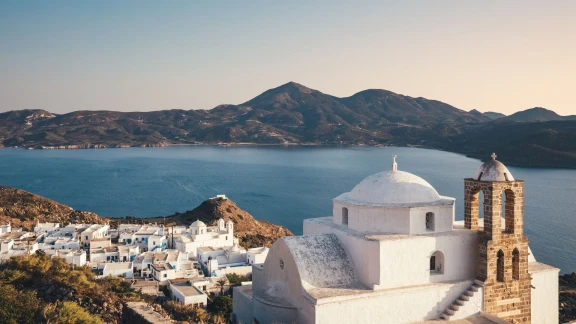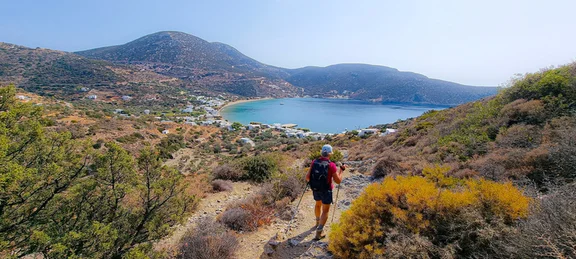


Amorgos is the most distant, the wildest of the Cyclades that travellers visit. Made famous by Luc Besson’s film The Big Blue (1988), it nonetheless stays off the well-trodden circuits of mass tourism. Behind the cinematic image lies an authentic Greece, made of ancestral paths, monasteries clinging to cliffs and villages where everyone knows everyone. To walk on Amorgos is to follow the thread of a time the other islands have sometimes forgotten.
| In brief | The wildest island in the Cyclades, famous for “The Big Blue”, to be explored along ancient paths. |
| Ideal for | Loving quiet walking, perched villages and coves that only the path reveals. |
| Best season | May, June and September: mildness, paths in flower or turned golden, moderate crowds. |
| Pace | Gentle, at your own rhythm, radiating out from Chora or Aegiali. |
| Our trip | Naxos and Amorgos self-guided, 10 days |
The monastery of Panagia Hozoviotissa
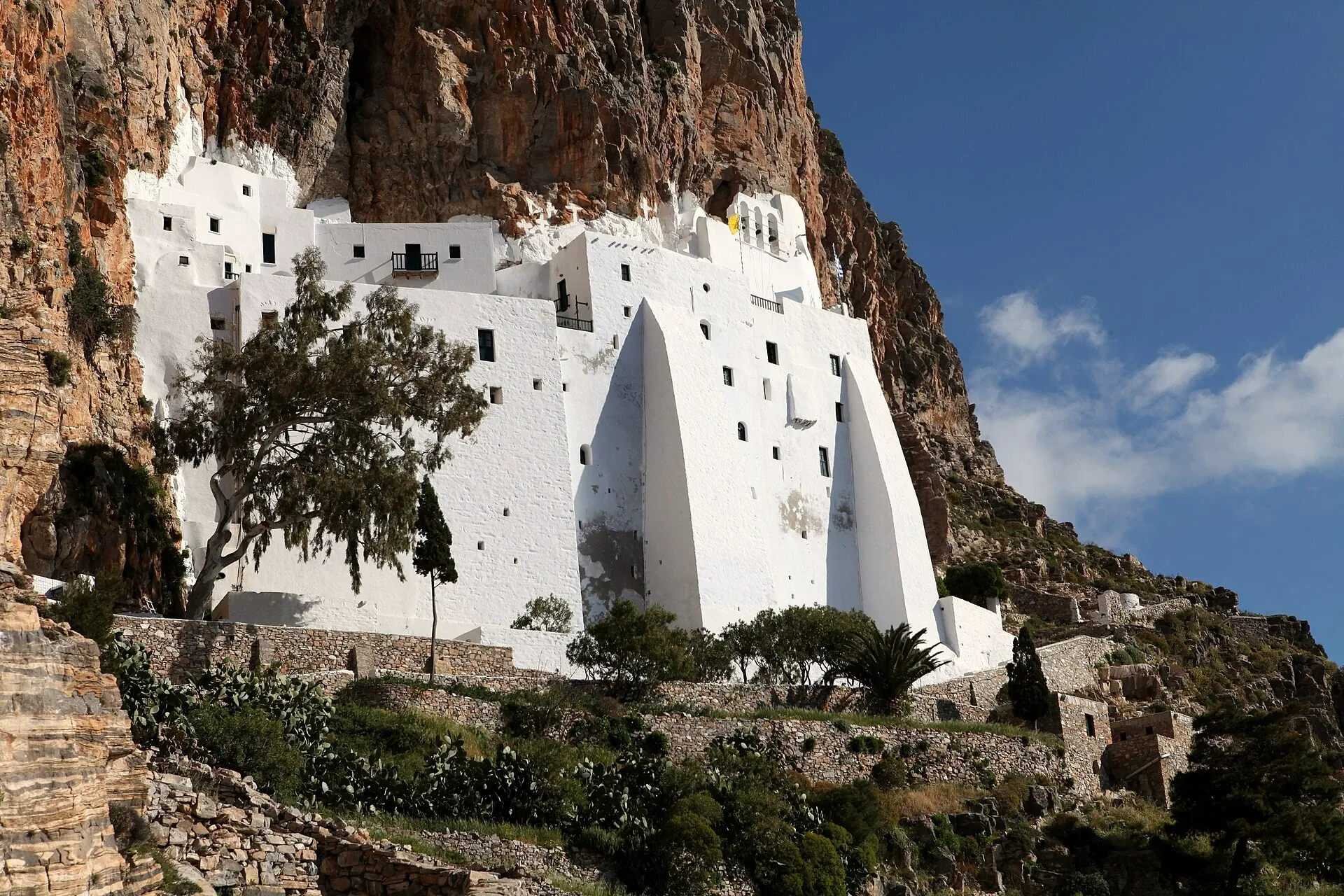
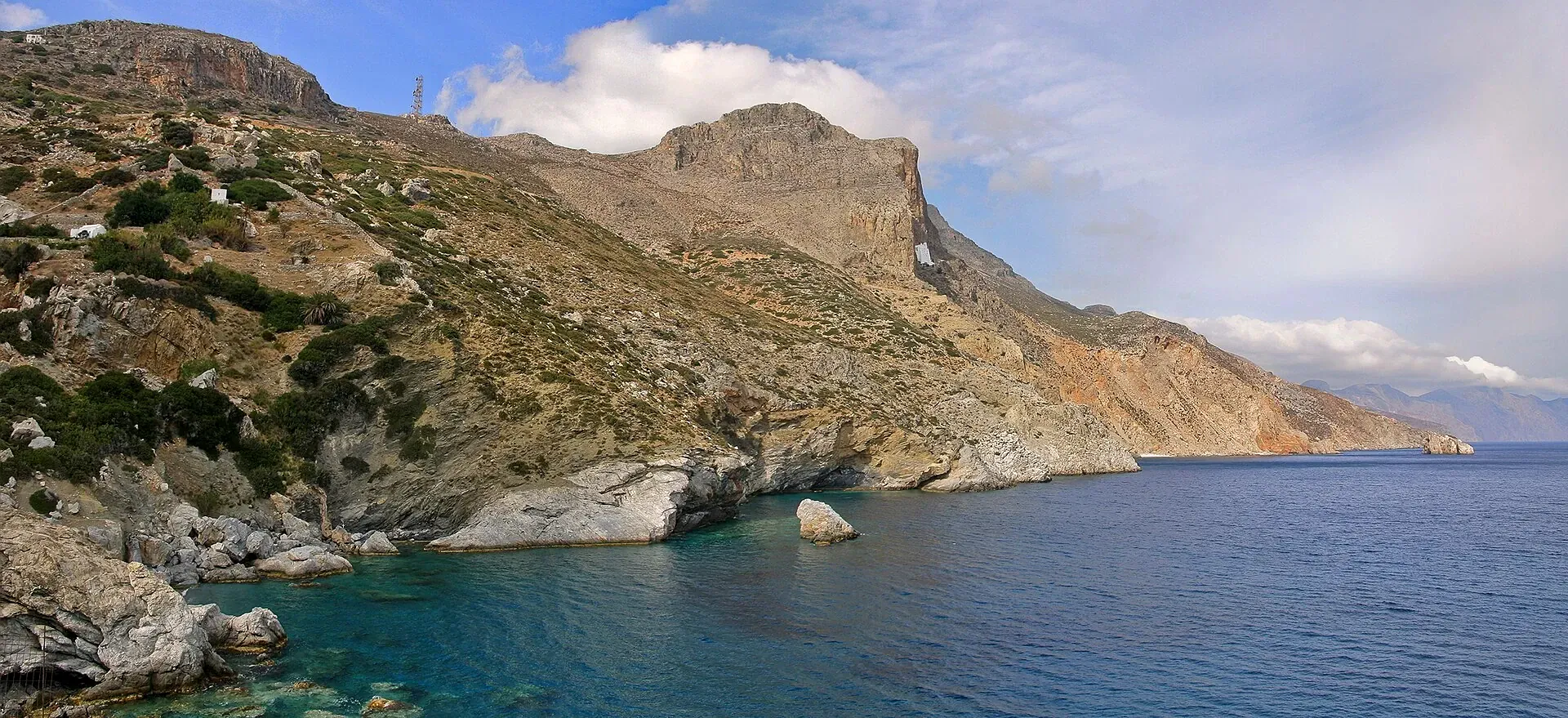
There are places that mark a traveller for ever. Panagia Hozoviotissa is one of them. This white monastery, set into a cliff three hundred metres above the Aegean, defies logic as much as gravity. You reach it from Chora, the island’s small capital, by a stone path winding along the mountainside.
The climb is gentle, between low walls and thyme bushes. Then, around a bend, the monastery appears: an immaculate white band pressed against the grey rock, as though painted onto the cliff. The effect is striking. You climb the last steps cut into the rock, pass through a narrow door, and enter a world apart.
Inside, eight levels of tiny rooms are stacked within the thickness of the wall. The monks who live here keep up a ritual of hospitality centuries old: they welcome every visitor with a glass of raki, a loukoumi and a smile. You sit on the terrace suspended above the void, facing the blue infinity, and you understand why this place has inspired contemplation since the 11th century. The monastery was founded to shelter an icon of the Virgin brought from Palestine, and that distant origin adds still more to the mystery. You leave with a light heart, feeling you have touched something essential.
From Chora to Aegiali: the great traverse
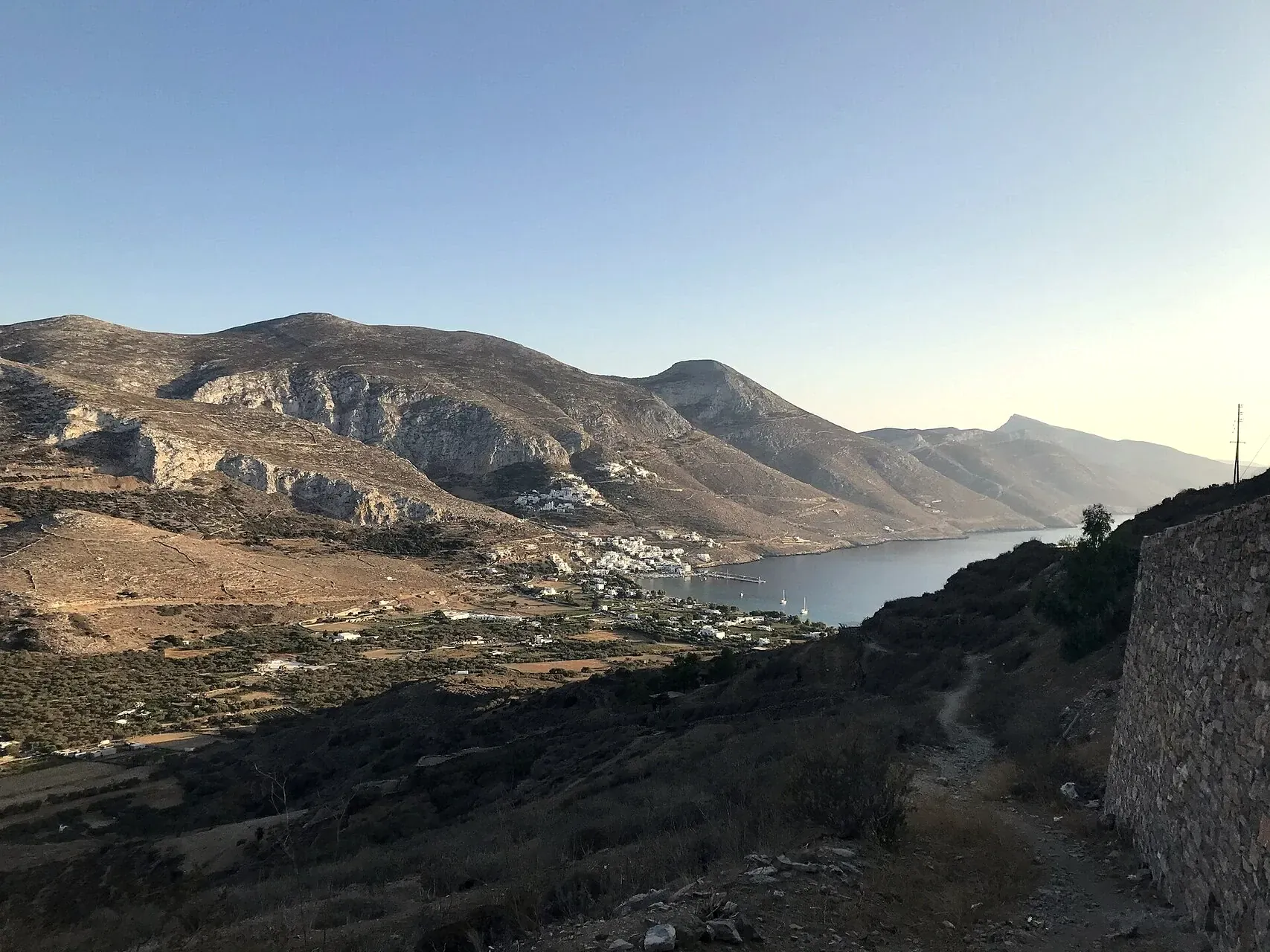
This is the queen of Amorgos walks, the one recommended to any walker with a full day. The path links Chora, in the south of the island, to the bay of Aegiali in the north, crossing the mountainous backbone that gives Amorgos its long, wild silhouette.
You leave Chora in the early morning, when the windmills still stand out against the mist. The path climbs quickly towards the island’s heights, through a landscape of low maquis and bare rock, taken over by silence. Not a sound, except the wind and the distant clink of a goat bell. Tiny chapels punctuate the route, whitewashed and locked. All of them keep their icons in the cool shade.
As the hours pass, the panorama opens over both coasts of the island. To the east, the sea plunges towards the Turkish shores. To the west, it stretches as far as Naxos and Paros, two islands people often struggle to choose between (our comparison Naxos or Paros will help you decide). You walk along the ridge, between sky and water, with the rare feeling of standing at the centre of the Aegean world.
The descent towards Aegiali is a reward in itself. The bay appears below, edged with white villages clinging to the hillside like birds' nests. You arrive with tired legs but a full mind, and sit down in a taverna on the harbour for a well-earned grilled fish. The evening bus takes those who would rather not walk back the same way home to Chora.
The bay of Agia Anna: the setting of The Big Blue
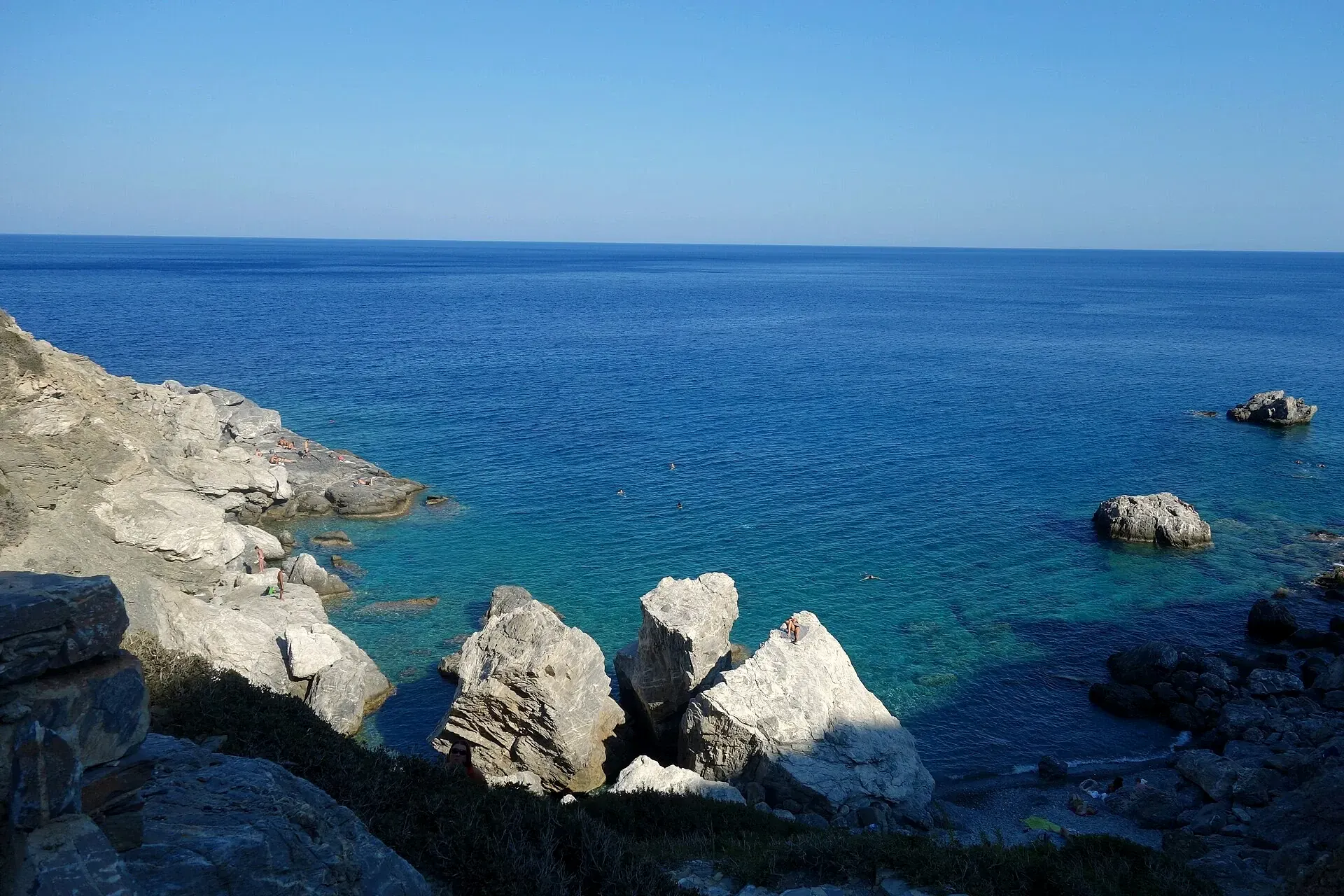
Below the monastery of Hozoviotissa, a small cove nestles at the foot of the cliffs. It was here that Luc Besson set up his cameras to film some of the most memorable scenes of The Big Blue. The water takes on shades of a blue so intense they look retouched, and yet they are not: it is the depth, the light, the white rock that create this unreal palette.
You go down by a steep path from the monastery, in barely a few minutes. The beach is tiny, made of smooth pebbles and flat rocks where you stretch out facing the sea. The cliffs frame the scene like the wings of a theatre. The silence is that of the seabed, barely troubled by the lapping of the waves.
To swim here is to step into the film. You think of Jacques Mayol, of that quest for depth which is also a quest for freedom. Then you climb back up, hair salted, towards the white monastery keeping watch above, and you feel strangely light.
The southern coastal path: Mouros and Kalotaritissa
The south coast of Amorgos is the island’s hidden face, the one you discover only on foot. A coastal path follows the cliffs to the most remote bays, where the land seems to crumble into the sea.
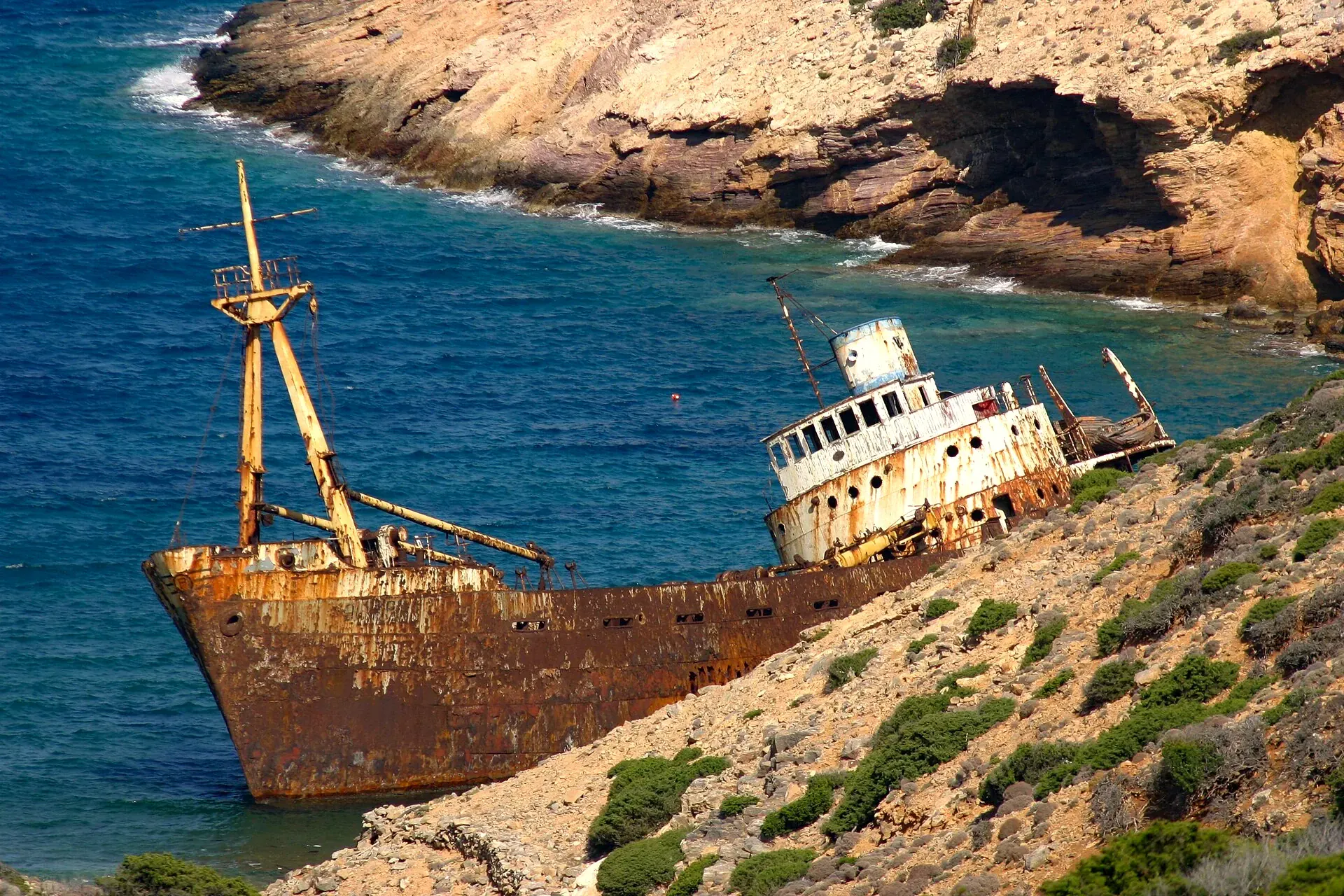
Mouros is the first reward. This beach is reachable only by the path, which gives it an absolute calm. A few tamarisks offer their shade, the water is transparent, and you are often alone. Further to the south-west, the bay of Kalotaritissa marks the end of the Amorgian world. It is here that the wreck of the Olympia rusts quietly, a cargo ship run aground in shallow water, visible from the shore. The sight is strangely beautiful: the rusted hull set on the turquoise sea, with nothing for a backdrop but hills stripped bare by the wind.
The landscape is harsh, swept by the meltemi, almost lunar in places. You walk with the feeling of being on the edge of something, at the fringe of the known world. This is the Amorgos of the ancient navigators, the one that has to be earned.
Tholaria and Langada: villages perched above Aegiali
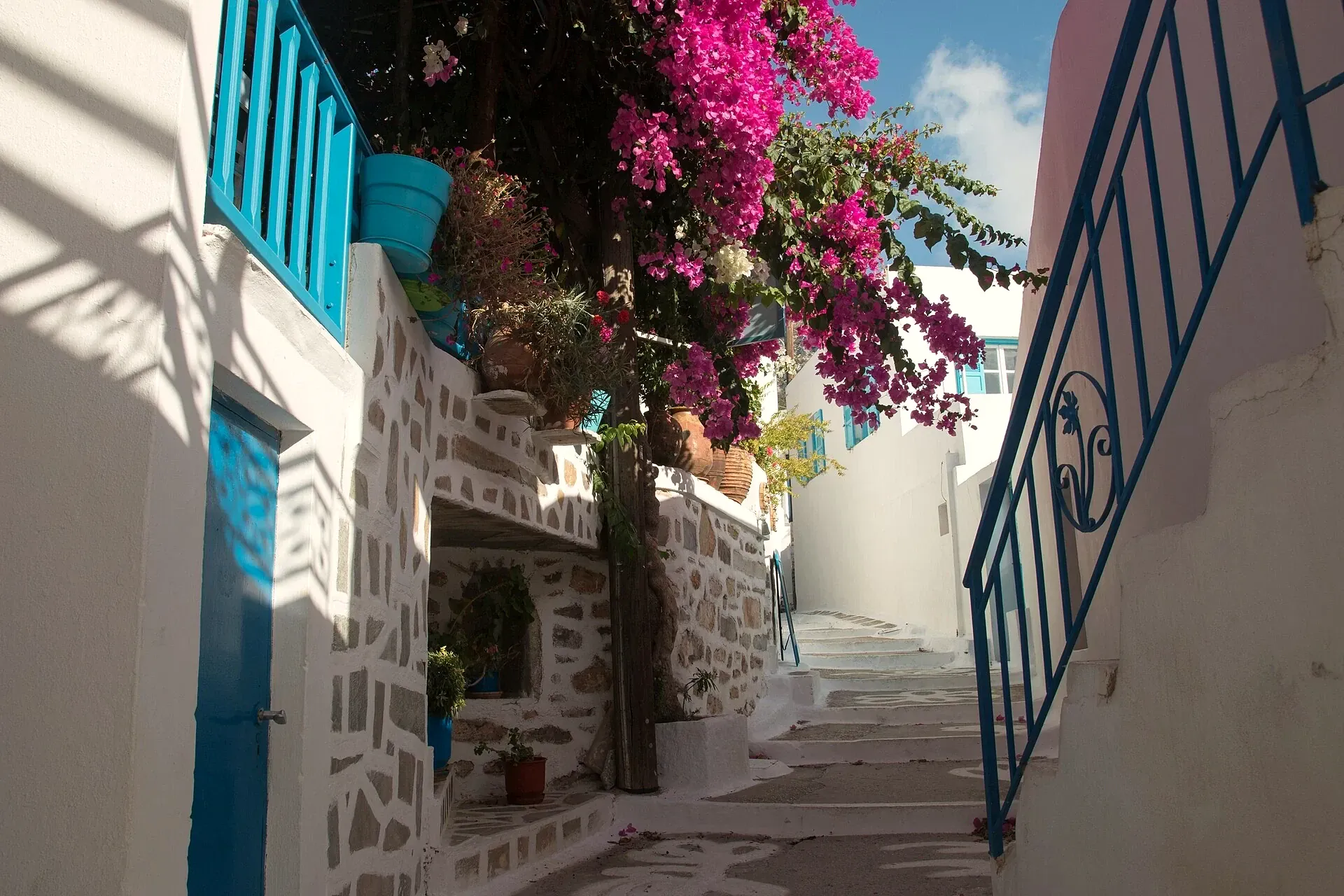
Above the bay of Aegiali, two villages face one another on the mountain flanks, linked by a web of mule tracks the inhabitants have used for centuries. Tholaria and Langada are the soul of Amorgos, the beating heart of an island that cultivates its art of living away from onlookers.
Tholaria is the smaller of the two, barely a handful of white houses around a shaded square. You sit down at the taverna To Panorama, whose terrace overlooks the whole bay. In the evening the cats doze on the low walls, the old men play tavli (Greek backgammon), and the golden light of sunset sets the bay below ablaze.
Langada is a little larger, a little higher, with a Byzantine church whose frescoes tell stories eight centuries old. In the village, Nikos’s taverna, run by the same family since 1950, serves food that changes every day according to the owner’s mood and the fisherman’s catch. The walk between the two villages is a delight. The path crosses terraced olive groves and passes goat enclosures. Here and there, a votive chapel decorated with fresh flowers keeps watch beside the path. You hear the bells of the flocks, you breathe in thyme and wild oregano. Sometimes a shepherd raises a hand in greeting.
It is at sunset that this walk takes on its full dimension. From the heights of Langada, the panorama over Aegiali, its three white villages and the sea turning pink composes a picture you do not forget.
The Big Blue: Luc Besson’s island
In 1988, a young French director chose Amorgos to film the story of Jacques Mayol and Enzo Molinari, two free-diving rivals and friends. The Big Blue made this confidential island known the world over. The tourists flooded in, then ebbed away, and Amorgos remained itself.
That is what strikes today’s visitor: the filming locations are still recognisable, but the island has not given in to the lure of cinematic commerce. No Big Blue museum, no branded souvenir shops. Just the sea, the cliffs, the white monastery, and that light Besson’s camera captured so well.
For those who have seen the film, walking these paths is a quiet pilgrimage. Mayol’s spirit seems to float on the deep waters surrounding the island. Looking at that bottomless blue from the heights of Amorgos, you understand why a man might want to lose himself in it. And why a filmmaker chose this precise place to tell that story of vertigo and freedom.
When to visit Amorgos
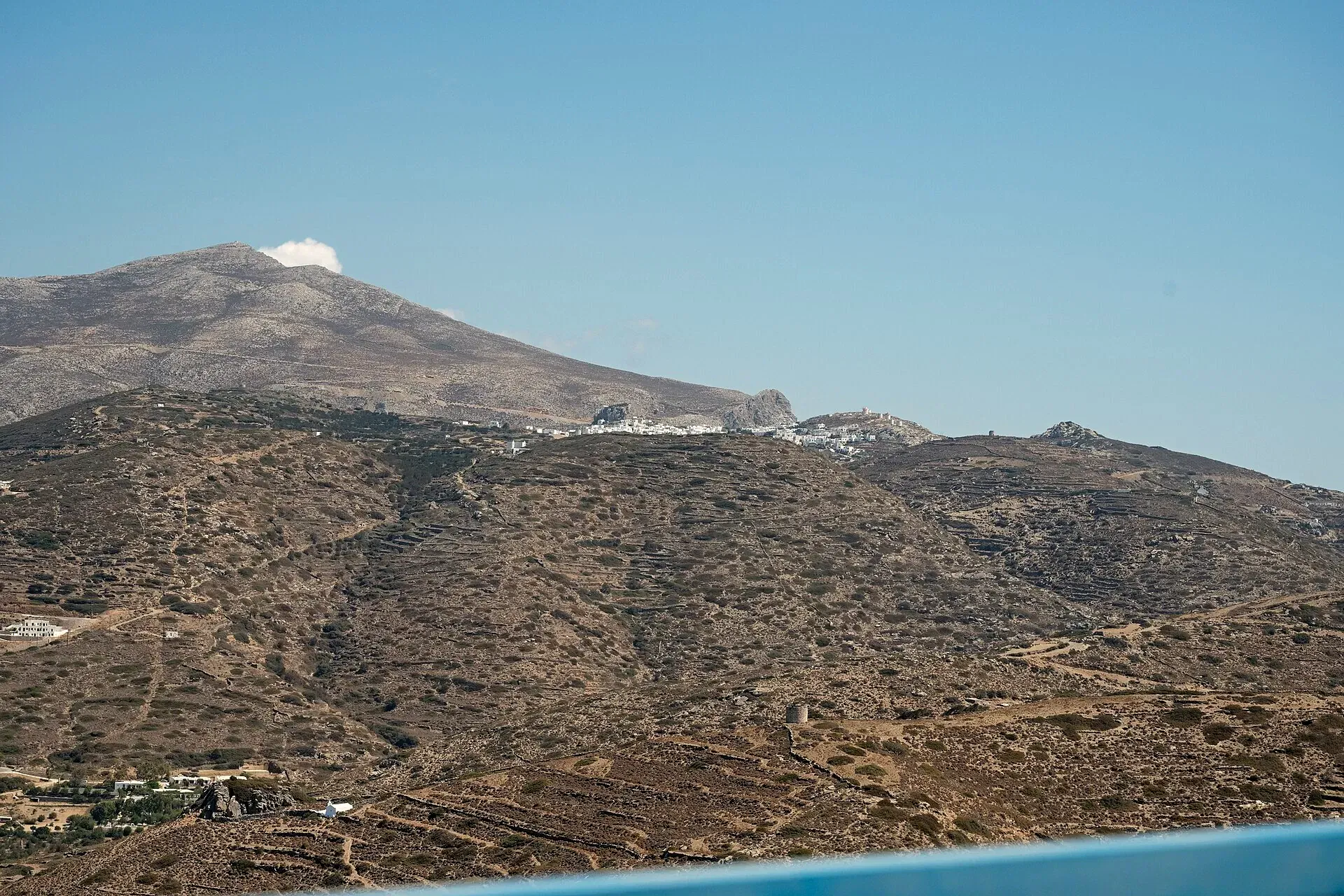
Amorgos is ideally discovered in spring and autumn. May, June and September offer the best conditions: gentle warmth, paths in flower or turned golden according to the season, and moderate crowds that preserve the island’s serenity. In summer the meltemi blows hard on the heights, which cools the walking but can make ferry crossings uncertain.
To reach Amorgos, the most usual route is a ferry from Naxos (1 to 3 hours depending on the boat) or from Piraeus, the port of Athens (7 to 9 hours depending on the boat). Connections also exist from the other Cyclades. This is in fact the sequence we like to offer: begin with the green valleys of Naxos before reaching the luminous harshness of Amorgos, as on our holiday Naxos and Amorgos self-guided, 10 days to link the two at your own pace. On the island, a small bus network connects Katapola, Chora and Aegiali, the three centres of life. But the real means of transport remains walking: the distances are short and the paths well marked. Every step reveals a stretch of landscape the road does not show.
Frequently asked questions about hiking in Amorgos
Do you need to be a strong walker to enjoy Amorgos? No. Most paths are walked at your own pace, on well-marked ancient tracks. The climb to the Hozoviotissa monastery is gentle, and the bay of Agia Anna is reached in a few minutes. The great traverse from Chora to Aegiali takes a full day, but nothing obliges you to do it in one go: a bus network lets you walk in sections and return whenever you wish.
What is the finest walk on Amorgos? Many agree on the traverse from Chora to Aegiali, which follows the island’s ridge between two seas. But the walk between the villages of Tholaria and Langada at sunset has its devotees too. It all depends on the mood of the day and the light.
Where can I find a walking map of Amorgos? Two reference Greek publishers cover the island: Anavasi (1:32,000) and Terrain (1:30,000). Both map the network of ancient paths with village-to-village distances, and are found in travel bookshops or online. If you walk with us self-guided, however, you have nothing to prepare yourself: our Naxos and Amorgos holiday comes with detailed route notes and the tracks for each itinerary, day by day.
How many days do you need to hike on Amorgos? Allow 3 to 4 days to taste the essentials: the climb to the Hozoviotissa monastery, the bay of Agia Anna, the traverse from Chora to Aegiali and the perched villages of Tholaria and Langada. To savour the island at your own pace, pairing it with its neighbour, we like to allow around ten days: that is the length of our Naxos and Amorgos self-guided holiday, which links the two islands on foot and by ferry.
Do you need a guide to hike on Amorgos, or can you go self-guided? The paths of Amorgos are ancient and well marked, which lends itself wonderfully to self-guided walking, at your own pace and according to how you feel that day. That is the formula of our Naxos and Amorgos holiday: you make your own way, route notes in hand, while we arrange the accommodation, the luggage transfers and the logistics in advance. If you prefer the conviviality of a small group and the eye of someone who knows the ground, we also run our Cyclades trips as guided trips, with an English-speaking leader.
Was The Big Blue really filmed here? Yes. Luc Besson filmed several scenes of The Big Blue (1988) on Amorgos, notably in the bay of Agia Anna, just below the Hozoviotissa monastery, and around Kalotaritissa for the wreck. The places have remained remarkably faithful to the film’s image.
Amorgos or another Cycladic island for a first visit? Amorgos appeals to those looking for calm and authenticity, rather than an easy first taste of the Cyclades. If you are still hesitating over the island that suits you, our guide which Cycladic island to choose reviews the character of each one.
Your question is not on this list?
Write to us, and we will reply to you personally by email.
Continue reading
- Which Cyclades island to choose for the trip you have in mind?
- Naxos or Paros: which Cycladic island suits the trip you want?
- Hiking in Sifnos: the island of flavours on foot
- Hiking in Greece: the best trails island by island
Article written by
Maria Papadopoulou (Μαρία Παπαδοπούλου)
Editorial lead
I hike, and Greece is the place I keep coming back to. My initial studies (a Master’s in Marketing and a degree in Applied Foreign Languages) taught me how to build an editorial project, and the trails taught me the… Read more