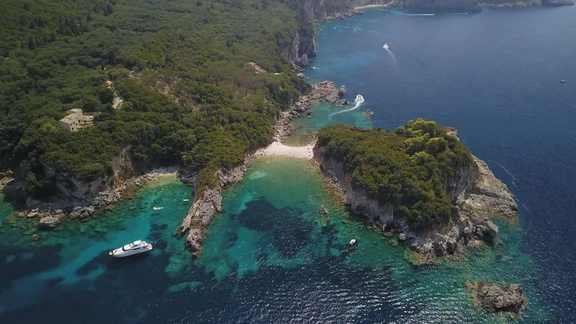


You are hesitating between two of the finest Ionian islands, and that is quite natural: Corfu and Kefalonia look alike from a distance, with their turquoise waters and their perched villages bathed in the same golden light, but they offer two very different trips once you are there. The first will win you over with its Venetian charm and its paths that are easy to walk. The second will leave you speechless before its wider, wilder landscapes. Here, quite frankly, is how to choose your Ionian island according to what really gives you pleasure.
| In brief | Corfu for walking and culture, Kefalonia for wide landscapes and cycling |
| Corfu, ideal for | the Venetian old town, coastal paths, a walking trip |
| Kefalonia, ideal for | spectacular panoramas (Myrtos, Assos), nature, cycling |
| Best season | May, June, September and early October (mildness, light, few people) |
| Pace | gentle, at your own rhythm, never sporty |
| Our holidays | Corfu on foot (self-guided or guided), Kefalonia by bike |
The essentials in two words: if you like wandering lanes charged with history and walking from one cove to the next, head for Corfu. If you dream of grand panoramas and prefer discovering an island along the road, choose Kefalonia. Both lie in the Ionian Islands archipelago, to the west of Greece, and both amply reward the traveller who takes their time.
Corfu, the greenest and the most Venetian
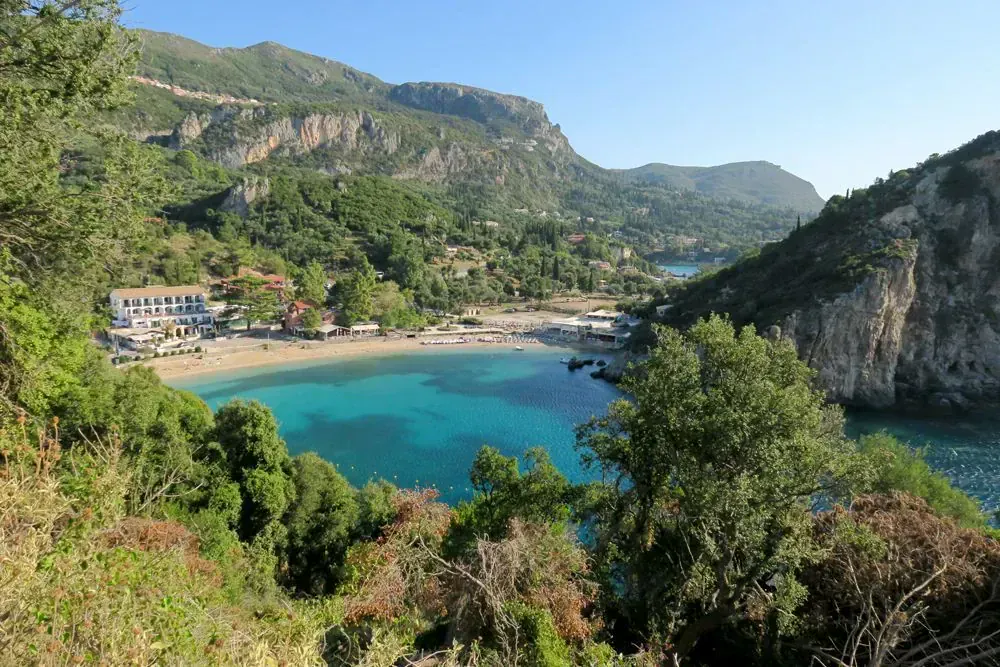
Corfu (Kerkyra to the Greeks) is the northernmost island of the archipelago, and probably the most cosmopolitan. Four centuries under the Republic of Venice, then the passage of the French and the British, have left it an elegance found nowhere else in Greece.
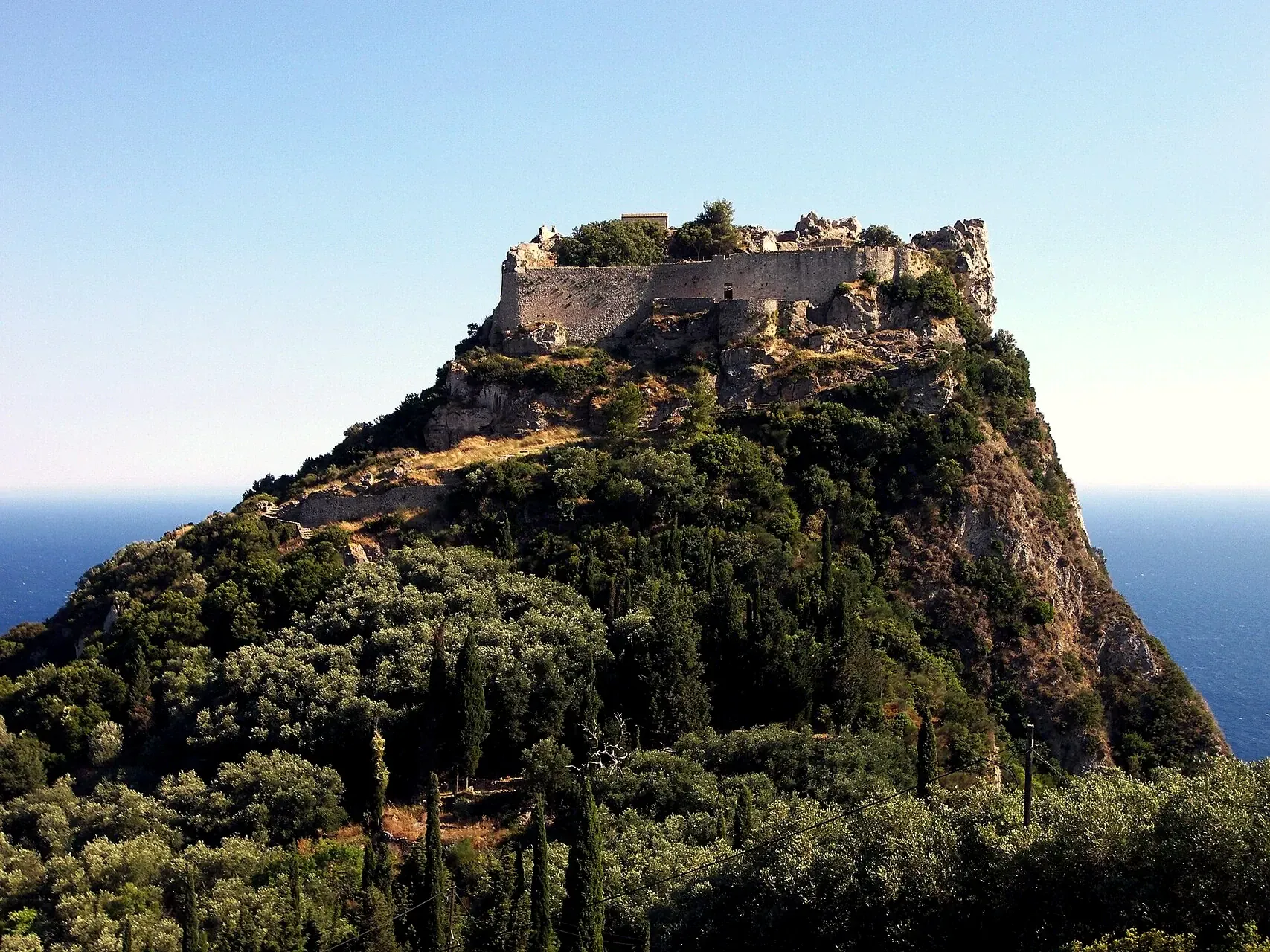
Its old town has been UNESCO World Heritage listed since 2007. You wander there without a map, following the cobbled lanes, between façades with coloured shutters, the Italianate arcades of the Liston and two imposing Venetian fortresses that watch over the sea. It is the kind of place where you sit down on a terrace for a coffee, simply to watch time go by.
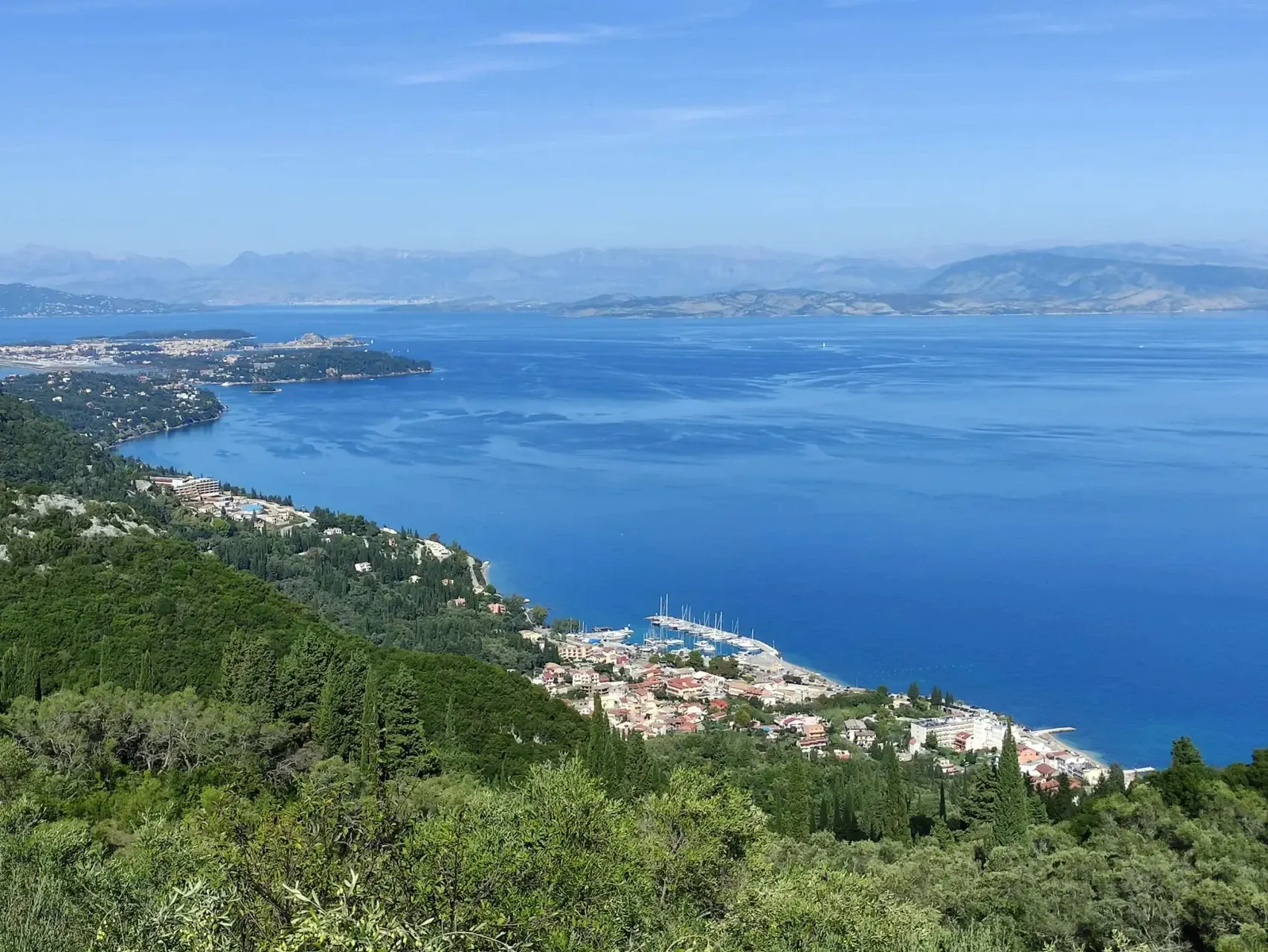
Beyond the capital, Corfu lives up to its nickname of the emerald isle: olive groves as far as the eye can see, green hills, translucent coves such as Paleokastritsa on the west coast. It is also the most welcoming island for anyone who likes walking. The coastal paths follow one another gently, in the shade of the olive trees, with almost always the sea below and a village for the lunch stop. Nothing sporty: walks at your own pace, where the pleasure comes from the landscape and the encounters, not from the effort.
At table, Corfu cultivates a cooking all its own, inherited from its Venetian past. There you taste sofrito (veal simmered with garlic and vinegar), pastitsada (a spiced meat dish served with pasta) or bourdeto, a piquant fish stew. All washed down with a local wine and a kumquat, the little candied citrus the island has made its speciality. So many good reasons to linger on a terrace.
Kefalonia, the largest and the most spectacular
Kefalonia plays in another category. It is the largest of the Ionian Islands, and the most mountainous: it is dominated by Mount Ainos, which rises to 1,628 metres, the highest point in the whole archipelago. Its summit, protected as a national park since 1962, shelters an endemic fir, Abies cephalonica, and even a few semi-wild horses.
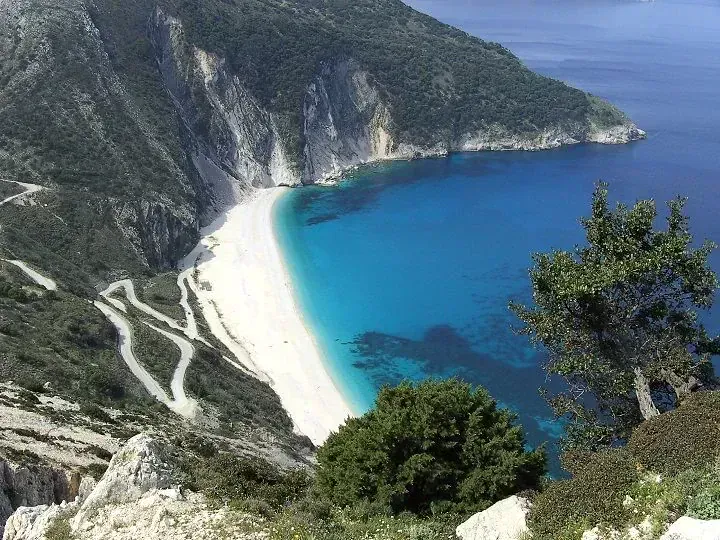
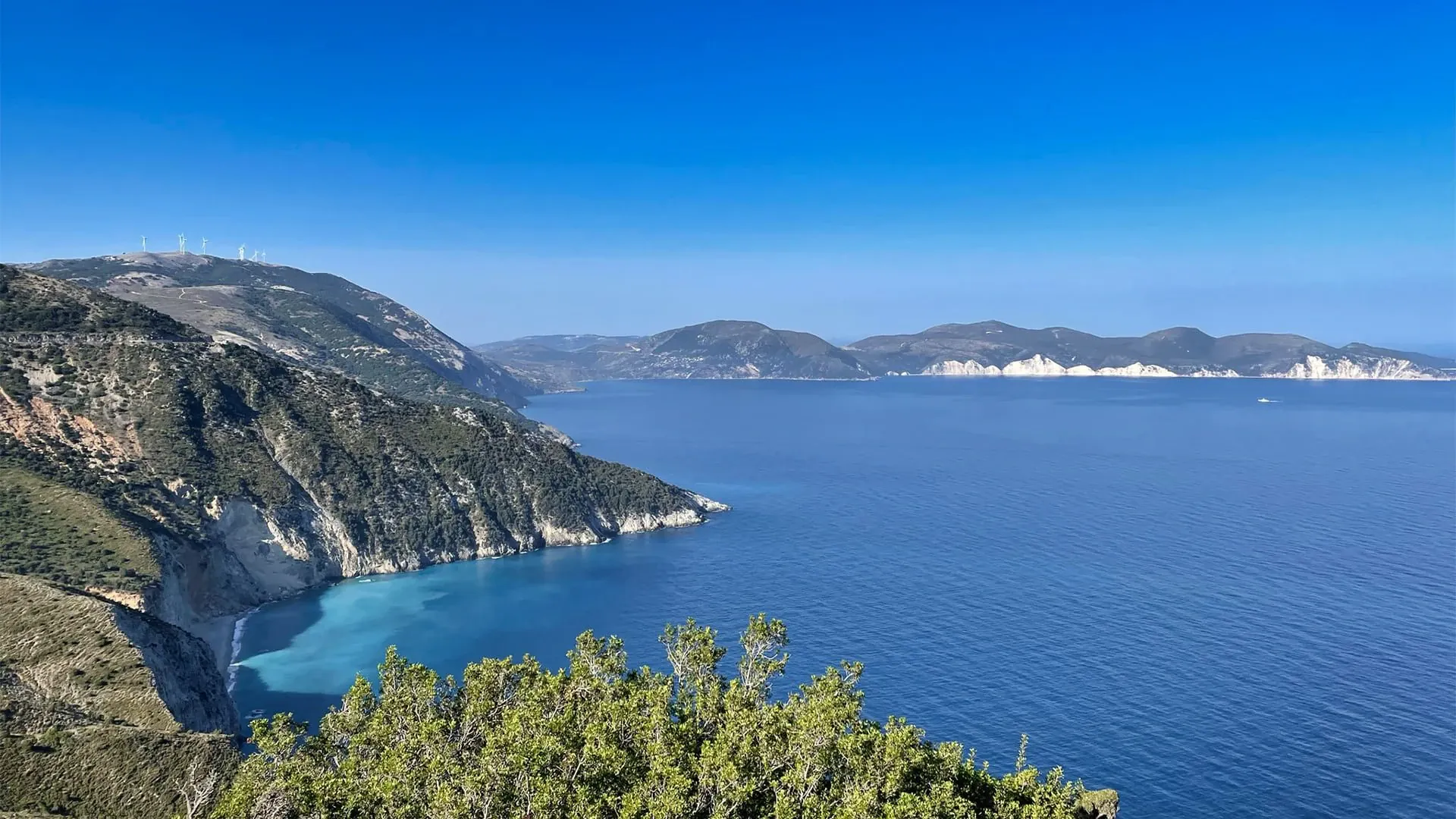
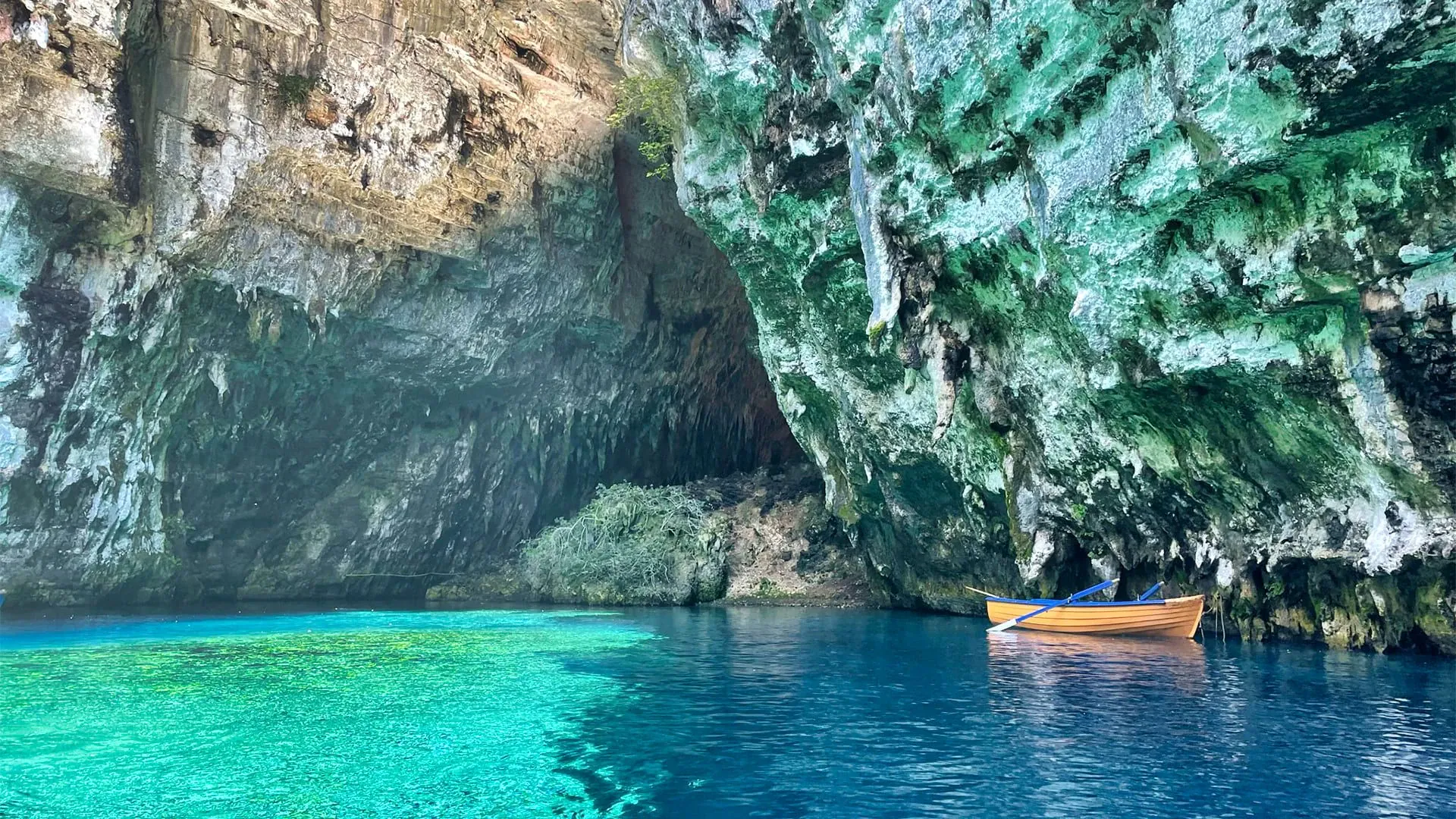
Here it is the wide landscapes that stay in the mind. Myrtos beach spreads its long band of white pebbles at the foot of a vertiginous limestone cliff: the view from the road above is one of the most photographed in Greece. Further north, the small village of Assos clings to an isthmus dominated by a Venetian fortress, its restored houses ranged around a little square shaded by plane trees. Not forgetting the underground lake of Melissani, whose waters take on an unreal tint when the sun slides through the opening of the cave.
Kefalonia is vaster, more spread out, and its wonders are far apart from one another. It is an island savoured along the road, or better still by bike, to link the bays and the villages without hurrying, with the welcome help of electric assistance on the climbs.
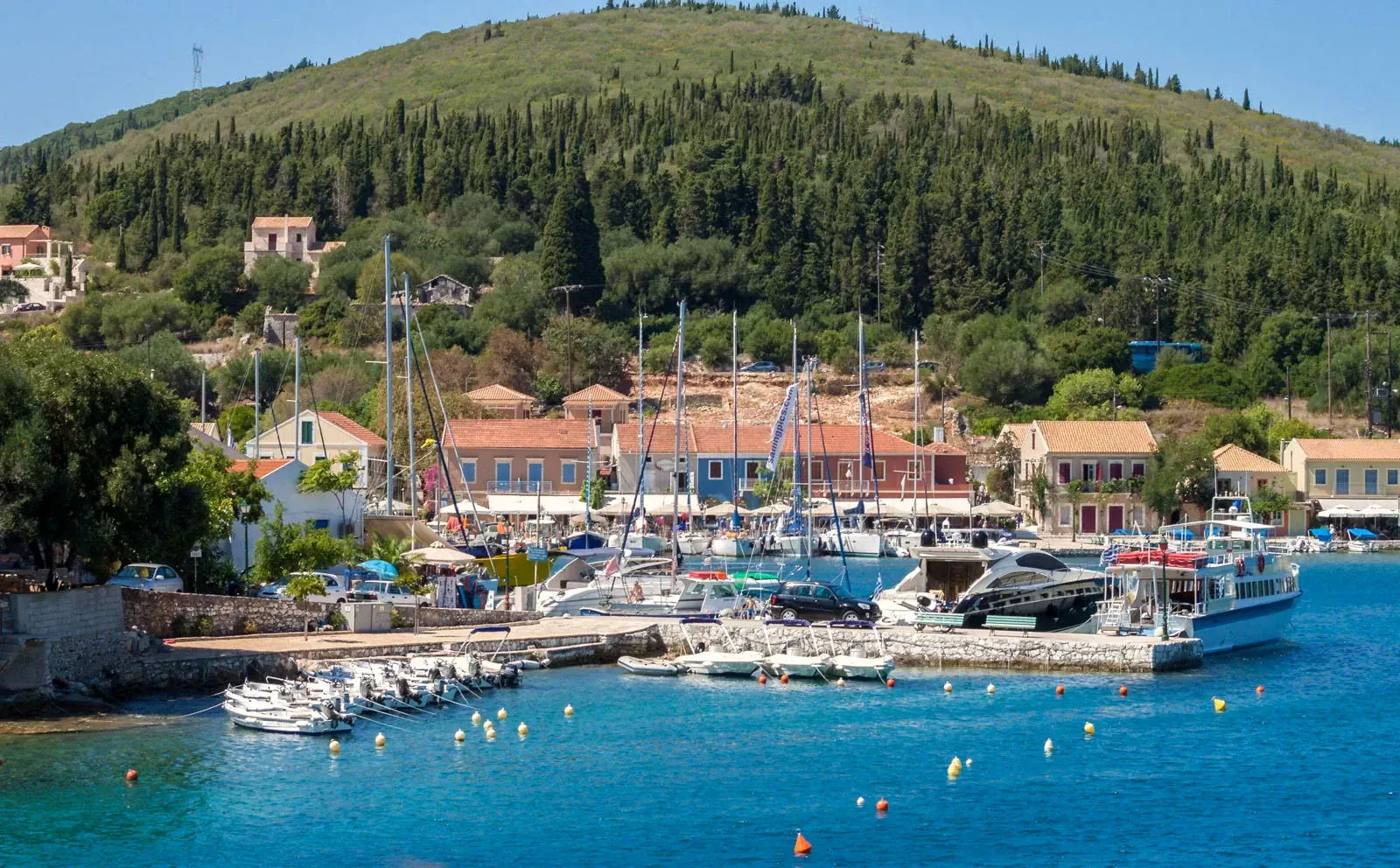
The island has also inspired writers: it is here that Captain Corelli's Mandolin is set, and the filming made the colourful lanes of Sami known. And then there is Fiskardo, the only village spared by the earthquake of 1953, with its pastel houses lined along a small harbour where the sailing boats moor. You dine there facing the water, in peace, far from the bustle of the big resorts.
Walking or riding: the real difference
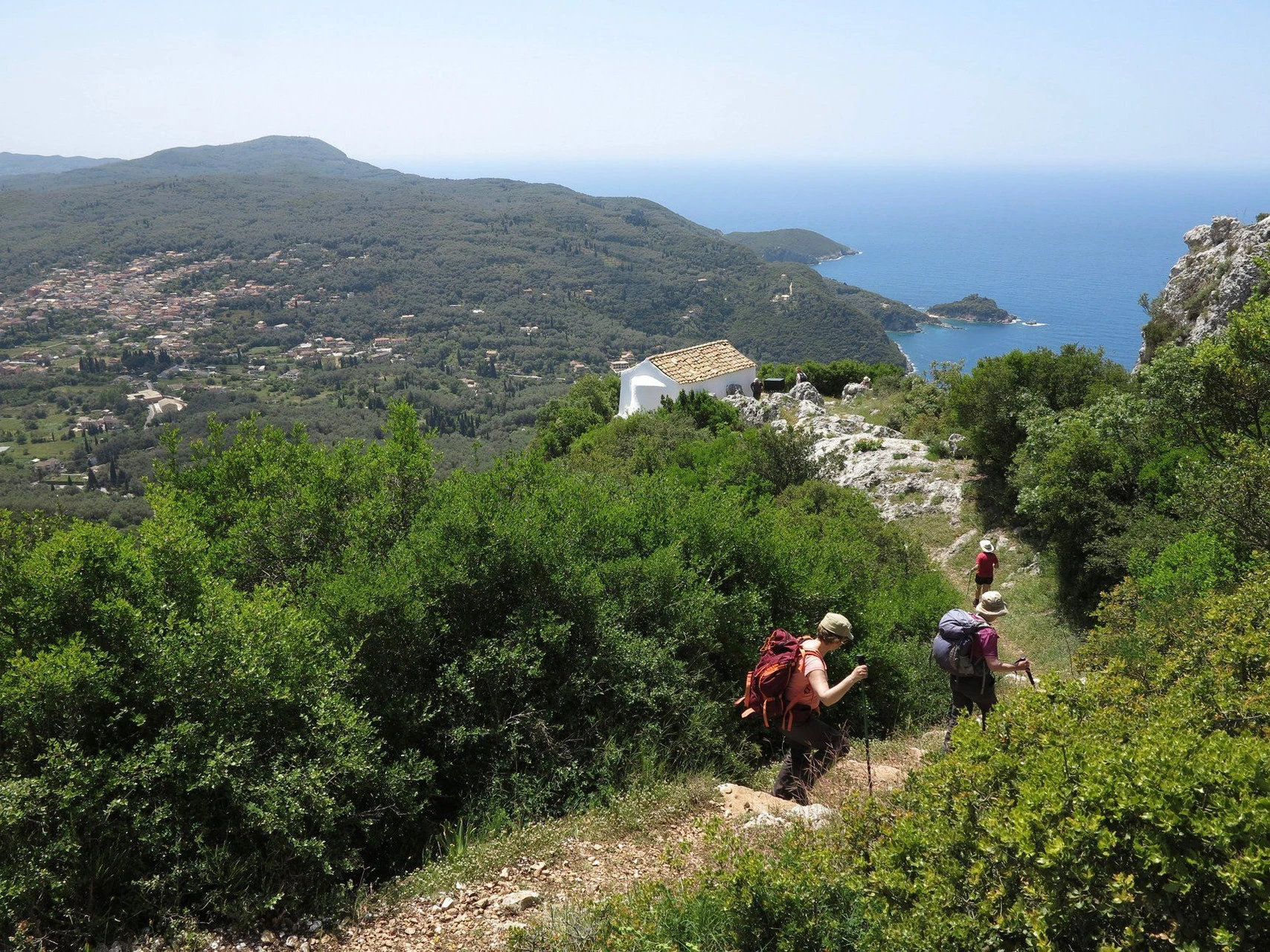
This is probably the point that will settle your choice. On Corfu, everything invites you to walk: the old town is covered entirely on foot, and the coastal paths link the villages in a setting of olive trees and coves. It is the island of the quiet stroll, where you move from one step to the next without ever straining.
Kefalonia, wider and hillier, lends itself better to a mobile discovery. The distances between the sites invite you to take the road, and the electrically assisted bike comes into its own: you link Myrtos, Assos and Argostoli at your own pace, enjoying the descents towards the sea and letting yourself be helped on the climbs.
That is exactly how we offer you these two islands. One honest detail: with us, Corfu is discovered on foot and Kefalonia is discovered by bike. We do not (yet) have a walking trip on Kefalonia. If walking is your absolute priority, it is therefore Corfu you should be looking at.
When to go, and for how long
For both of them, the fine season stretches from May to early October. We advise avoiding the height of summer, July and August, hotter and busier. May offers nature still green and in flower, perfect for walking on Corfu. June and September bring together the best of both worlds: a sea already (or still) good for swimming, luminous days and reasonable numbers. Early October remains very pleasant, with a mildness suited to long walks.
Reckon on a good week on the spot to really enjoy an island without rushing. Corfu suits a walking holiday of 7 or 8 days, time to alternate the old town and the coastal paths. Kefalonia, wider, deserves the same time to link its sites by bike without hurrying anything. And if you have 2 weeks ahead of you, nothing stops you combining the two. Just be aware that there is no direct ferry between Corfu and Kefalonia: the link passes through other islands (Paxos, Lefkada, Ithaca) and remains irregular out of season. The simplest is then to plan each island as a trip in its own right.
Our holidays for discovering each island
For Corfu, you have a choice of two formulas. In complete independence, Corfu, the Emerald Isle has you making your way from one cove to the next, at your own pace, with your stages booked and your luggage waiting on arrival. To combine two islands with a leader, Corfu and Paxos, a journey in the Ionian Islands adds the confidential gentleness of little Paxos, famous for its sea caves and its deep blue waters.
For Kefalonia, it is the bike that opens the island to you: Kefalonia, jewel of the Ionian Islands takes you, self-guided and with electric assistance, from the coast to the perched villages, to taste those panoramas mentioned above without ever labouring on the climbs.
In both cases, the charming addresses are chosen for their character and their comfort, the luggage transfers are organised, and you have only to enjoy. Forty years of experience have taught us one simple thing: on these islands, the real luxury is taking your time.
So, Corfu or Kefalonia?
Let us say it frankly, there is no bad choice. If you want to walk among olive trees, lose yourself in a UNESCO-listed Venetian old town and savour a cosmopolitan atmosphere, Corfu is for you. If you are looking for wider, wilder landscapes, and the wish to link far-apart wonders by bike, Kefalonia will delight you.
And if you really cannot decide, know that the archipelago lends itself well to a trip in two stages. Many of our travellers come back a second year to discover the other island. The light of the Ionian is the same everywhere: soft in the morning, golden in the evening, made for long tables and swims that never end.
Frequently asked questions about Corfu and Kefalonia
Corfu or Kefalonia for a first discovery of the Ionian Islands?
For a first trip to the archipelago, Corfu is often the most natural way in: its UNESCO-listed old town is visited on foot and its coastal paths stay gentle, in a cosmopolitan atmosphere that wins you over from the moment you arrive. Kefalonia will speak more to those who dream straight away of wide spaces and wilder landscapes. So people gladly begin with Corfu for the culture and the walking, keeping Kefalonia for the breadth of its panoramas.
Which island has the finest beaches?
Both islands are superb, in different registers. Corfu multiplies translucent, easily reached coves, such as Paleokastritsa on the west coast, nestled among the olive trees. Kefalonia plays the card of grand spectacle with Myrtos, its long beach of white pebbles at the foot of a vertiginous cliff, one of the most photographed in Greece. If you like stringing together small sheltered coves, lean towards Corfu; if you dream of a grand panorama, it will be Kefalonia.
Should you choose Corfu for walking and Kefalonia for cycling?
That is precisely the logic of our two formulas. On Corfu, everything is savoured on foot, self-guided with Corfu, the Emerald Isle or guided with Corfu and Paxos. Kefalonia, wider, is ideally linked by electrically assisted bike with Kefalonia, jewel of the Ionian Islands, whose assistance flattens the climbs. In short, Corfu for lovers of walking, Kefalonia for those who like moving on along the road.
Can you combine Corfu and Kefalonia on the same trip?
Yes, provided you have a good fortnight, as each island deserves a week without rushing. Be aware, however, that there is no direct ferry between them: the link passes through other islands, such as Paxos, Lefkada or Ithaca, and remains irregular out of season. The simplest is to plan each island as a trip in its own right, even if it means coming back another year to discover the second.
Your question is not on this list?
Write to us, and we will reply to you personally by email.
Continue reading
- Which Greek island is right for you? The complete guide
- The Best Hikes in Corfu
- Corfu and Paxos on Foot: a travel journal from the Ionian Sea
- Hiking in Greece: the best trails island by island
Article written by
Maria Papadopoulou (Μαρία Παπαδοπούλου)
Editorial lead
I hike, and Greece is the place I keep coming back to. My initial studies (a Master’s in Marketing and a degree in Applied Foreign Languages) taught me how to build an editorial project, and the trails taught me the… Read more