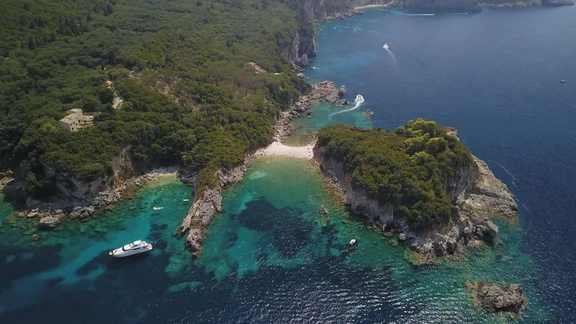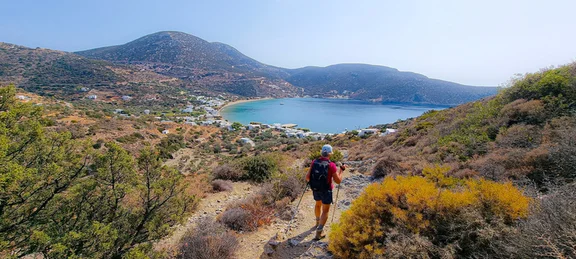


Picture a village clinging to a ridge, right up in the north of the island, where women still wear their grandmothers' embroidered dresses every day and where dark bread comes out of a wood-fired oven fed by flour from the last working mill. That village is Olympos, and on its own it sums up what makes walking in Karpathos so particular: here you do not walk to arrive, you walk to go back in time. Set between Rhodes and Crete, in the south of the Dodecanese, Karpathos has stayed away from the great flows. The wind blows often, the light is clear, and the ancient paths linking the hamlets of the north offer you a Greece of before, the one we thought had disappeared.
| In brief | The wild island of the Dodecanese, between the perched village of Olympos and turquoise coves, on old mule tracks |
| Ideal for | Curious travellers who love living culture, light and swimming more than crowds |
| Best season | May, June, September and October, when the heat stays mild and the sea is still good |
| Pace | Gentle, at your own rhythm, on panoramic paths and paved kalderimia |
| Our trip | No Kelifos trip on Karpathos yet: free inspiration, to be put together for now by your own hand |
Olympos, a village that has kept its world
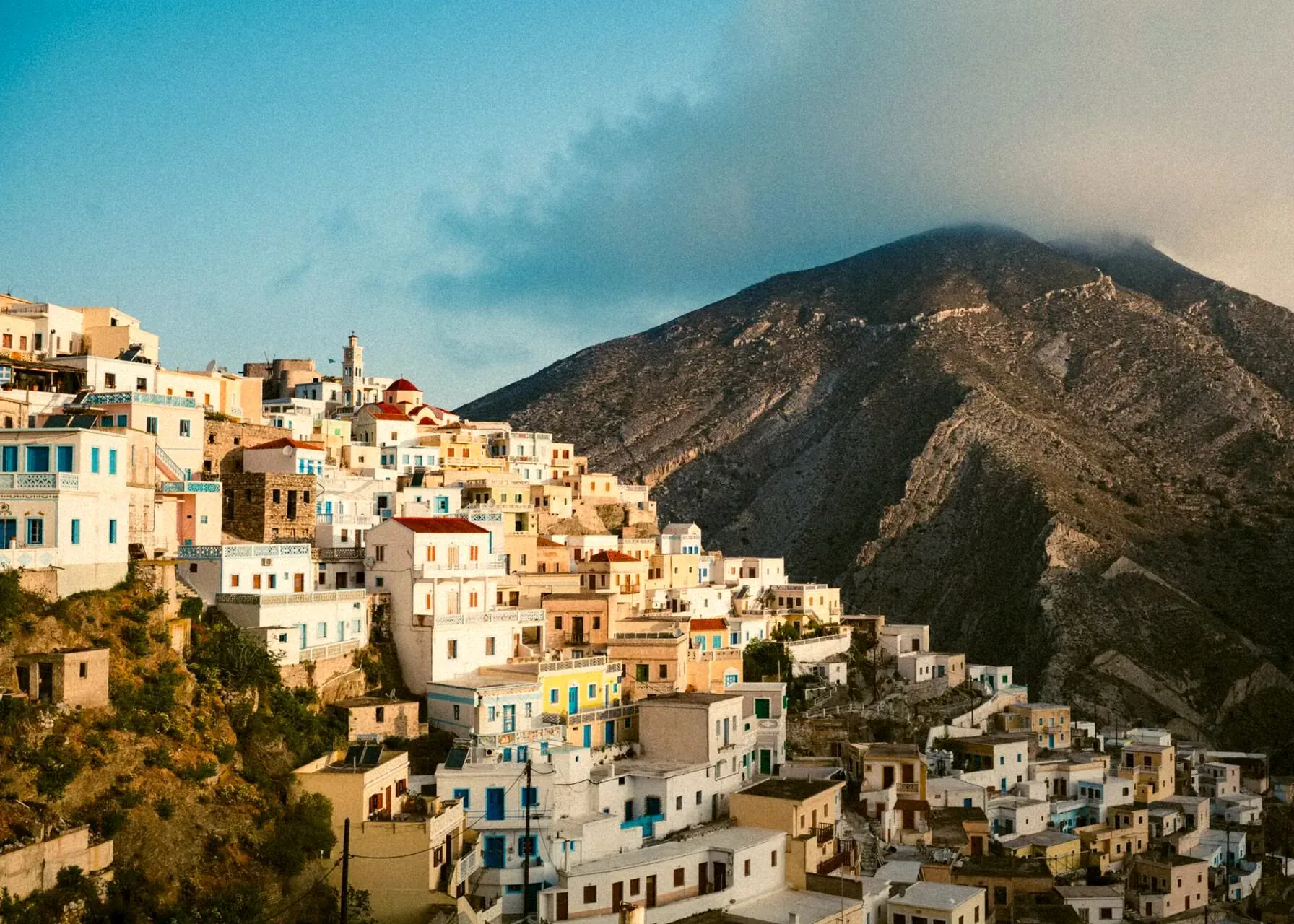
You reach Olympos by a winding road, but the finest way is still to arrive on foot, by the path that climbs from the small harbour of Diafani. The village appears suddenly, tiered along its ridge, its houses with coloured wooden balconies pressed against one another facing the sea. Olympos is not a set reconstructed for visitors: it is a living village, where a particular dialect is still spoken, where the patron saint's festival brings the whole community together, and where a few grandmothers go about their business in traditional dress as they always have.
Take the time for a halt in a taverna on the main street. There you taste the local goat's cheese, makarounes (small home-made pasta topped with fried onion and cheese), and that famous dark bread baked in the communal oven. Above the village, the restored windmills recall that here, until recently, people lived largely on what the mountain gave. It is this self-sufficiency over several centuries that has preserved Olympos from the passing of time.
The ancient paths of the north, the soul of the island
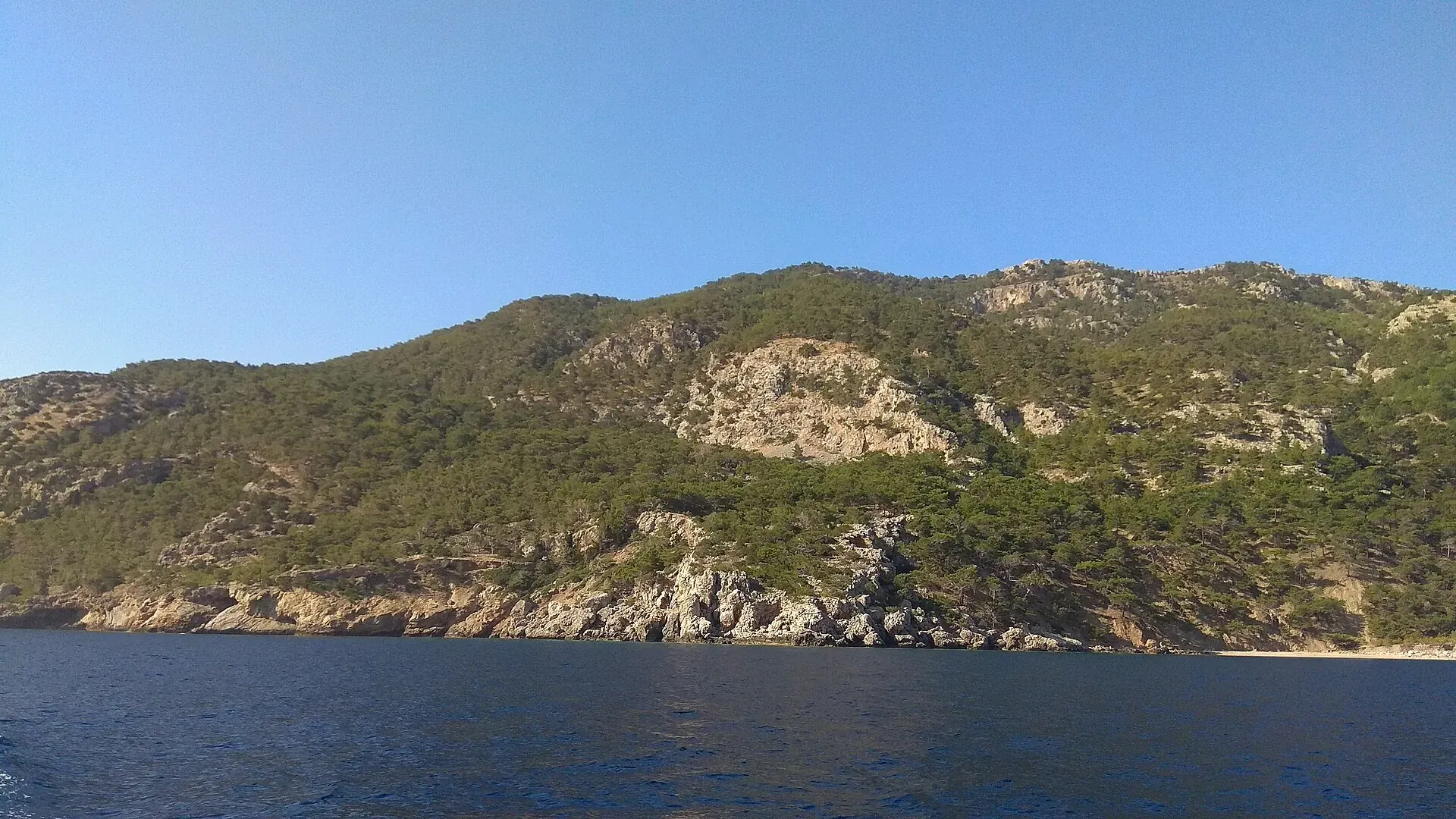
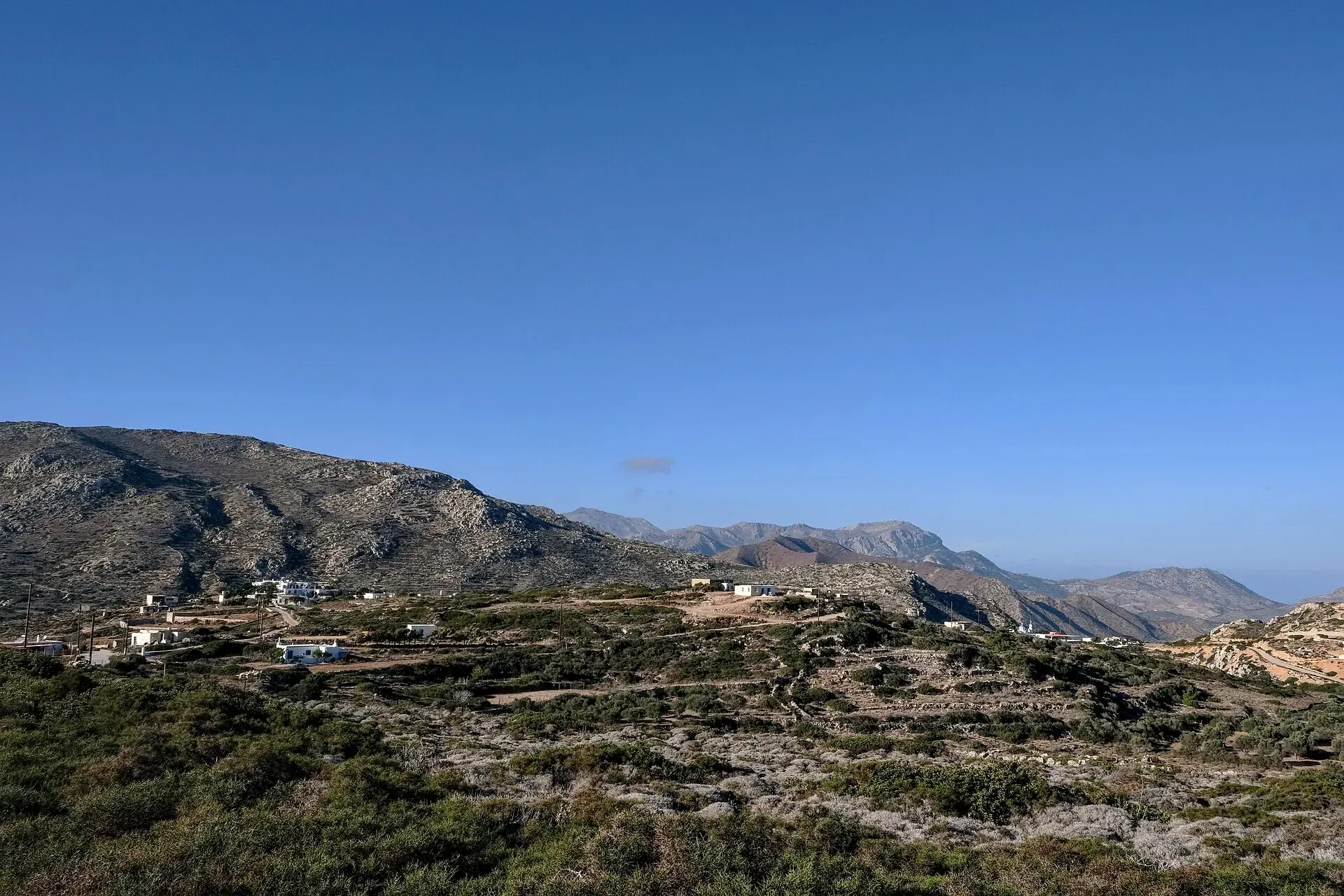
The north of Karpathos is a territory for quiet walkers. The villages of former times were linked by kalderimia, those paved mule tracks you follow today from one hamlet to the next. The finest of these walks sets off from Diafani and reaches Avlona, a tiny farming hamlet set on a plateau, before gaining Olympos. Reckon on about an hour and a half between each stage, on paths that are often panoramic and wonderfully solitary: it is not unusual to meet nobody other than a shepherd and his goats.
What strikes you on these paths is the silence and the scale of the landscapes. The vegetation is low, sculpted by the wind, and the sea appears at the turn of every ridge. You walk in the shade of the old dry-stone walls, you pass whitewashed chapels, you make out the silhouette of other Dodecanese islands in the distance. Nothing is pressing. It is exactly the kind of gentle walking we love to share: accessible to all, and punctuated by long pauses facing the blue.
Saria, the island of shepherds
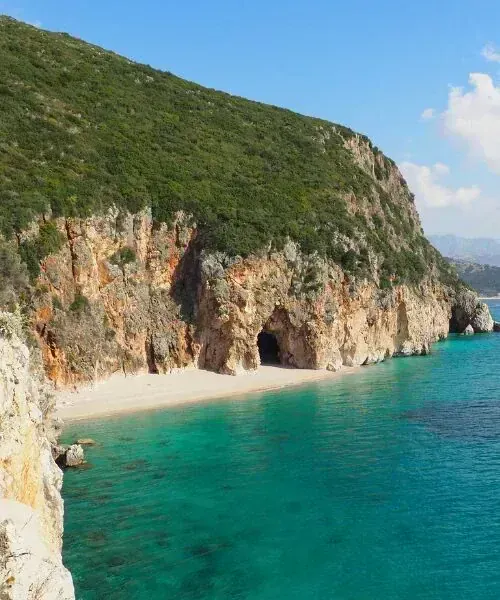
At the northern tip of Karpathos, separated by a narrow channel, the islet of Saria deserves a day to itself. Uninhabited, or nearly (a few shepherds spend the summer there with their donkeys), it is reached by small boat from Diafani when the sea allows. You land in a cove of limpid water, walk as far as the remains of an old village and an early Christian basilica, and enjoy a swim in a setting of rare purity. Remember to bring water and a picnic: there is no shop, and that is precisely what makes the charm of the place.
Diafani, the small harbour from which these excursions leave, is also worth lingering in. It is a quiet mooring lined with tavernas, where the fishing boats come back at the end of the day and where you dine facing the sunset. Many walkers make it their base camp for exploring the north of the island: you breathe another tempo there, that of an island Greece which has not bent to mass tourism.
Apella, Lefkos and the reward of a swim
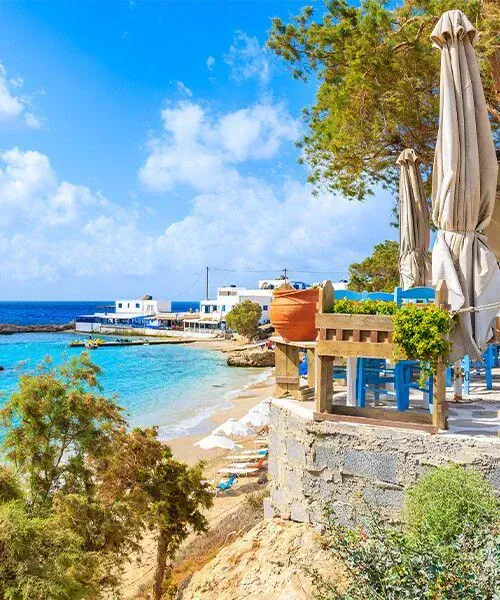
On Karpathos, every walk ideally ends with your feet in the water. Apella, on the east coast, is often cited among the finest beaches in Greece: white pebbles, turquoise water of astonishing transparency, and the welcome shade of a few pines. You go down by a path from the road, which discourages the crowds and preserves the quiet of the place.
On the west coast, Lefkos on the contrary unrolls a succession of small bays of golden sand, more sheltered, ideal for a quiet end of afternoon with a table of grilled fish in prospect. Above, the village of Mesochori tiers its white lanes and its chapels at the cliff edge, one of the most endearing in the west. Between the two, the island's interior holds other surprises: the villages of Volada, Othos and Aperi, clinging to the slopes, live slowly around their shaded squares and their small churches.
Mount Kali Limni, the roof of Karpathos
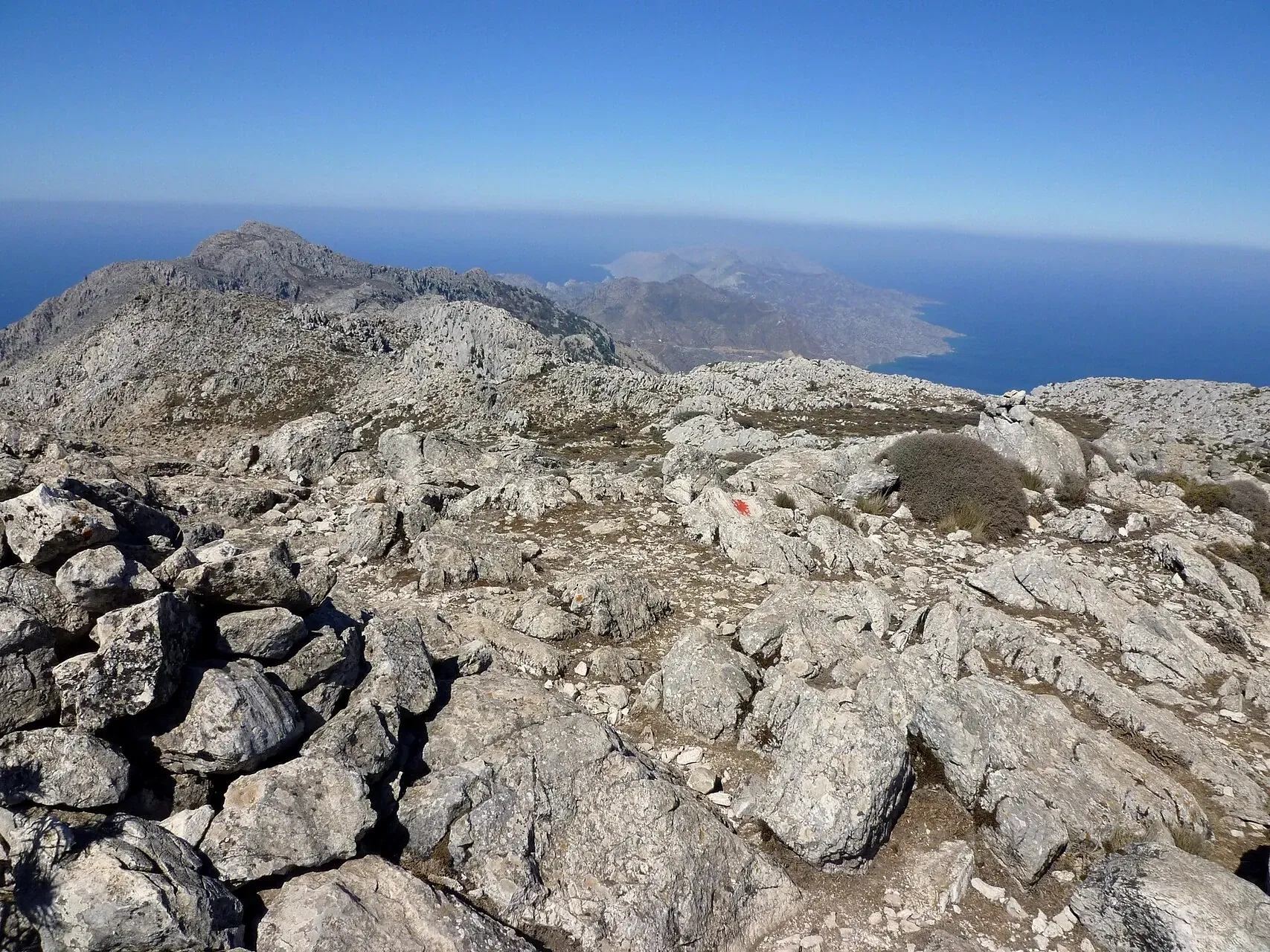
For anyone who likes to gain a little height, Mount Kali Limni is the highest point on the island, at 1,215 metres. You climb it only on foot, by paths setting off from the villages of the centre. The summit is nothing like a sporting feat: it is a long steady climb, tackled in the cool of the morning and at your own pace. The reward, at the top, is a 360-degree panorama over the whole island, over the Aegean and, in clear weather, over the neighbouring islands. Many prefer to stop halfway, on a panoramic shelf, for the simple pleasure of the view and a picnic. On Karpathos, the goal is never the summit: it is the path.
Living the island at its own pace
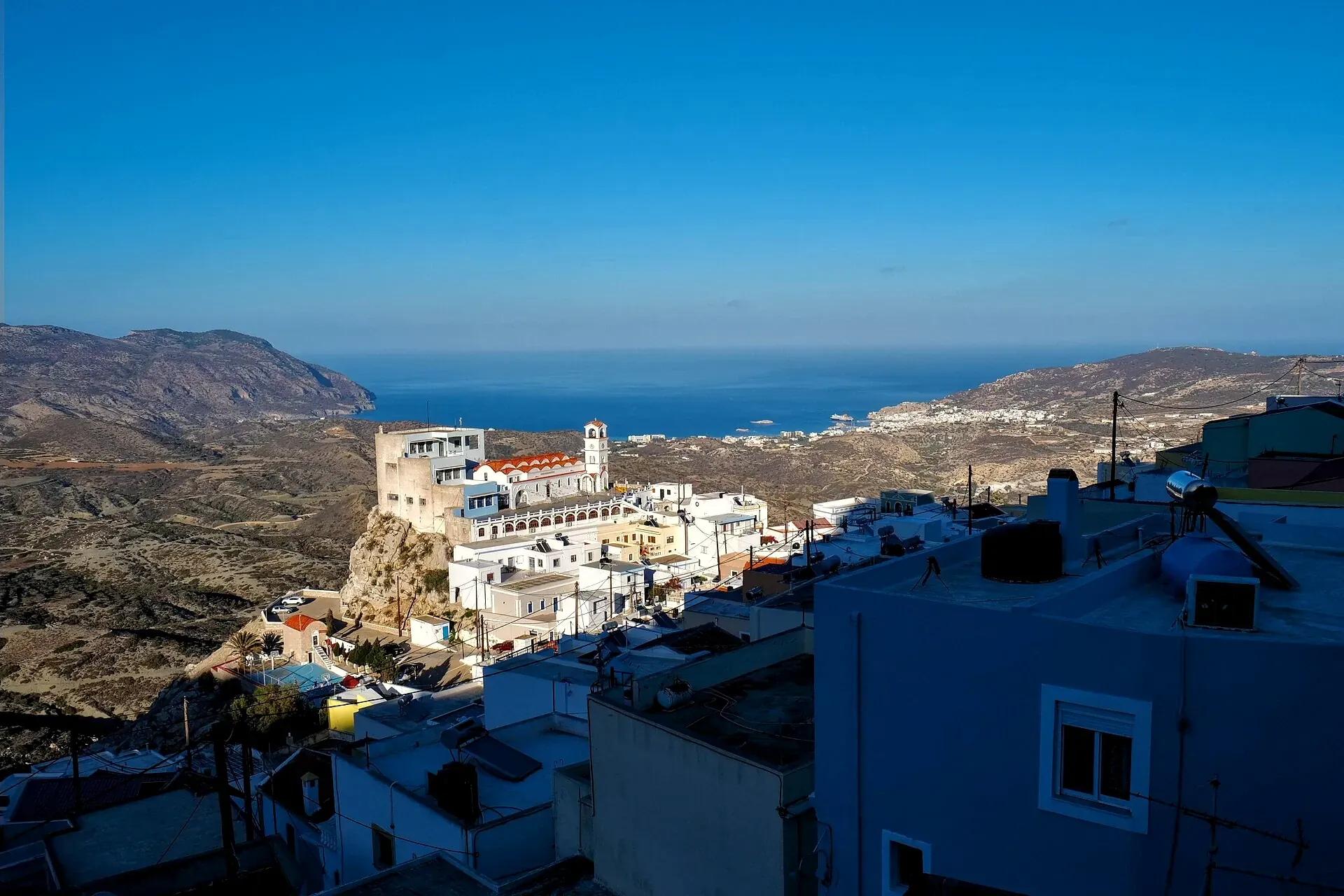
Karpathos has to be earned a little, and so much the better. The island is reached by plane from Athens or by ferry from Rhodes and Crete. The wind, especially in summer, makes the reputation of the south among windsurfers, but it also agreeably cools the walks of the north. The best seasons for discovering the island on foot remain spring, from May to June, when the countryside is still green and in flower, and autumn, in September and October, when the sea keeps the mildness of summer and the paths recover their calm.
One last thing we would have liked to know before setting off: allow yourself time. Karpathos is not an island you tick off in 2 days. It is an island where you linger, where you come back to dine twice in the same taverna, where you learn first names. Walking there is less an activity than a way of letting yourself be carried by the rhythm of the place.
Karpathos is not yet in the Kelifos catalogue
Let us be transparent: we do not, to date, offer a walking trip dedicated to Karpathos. The island remains, for now, an inspiration to savour freely. If you dream of perched villages, ancient paths and solitary coves in the same spirit, several of our pages will help you choose your next Greek destination. Begin with our guide to choosing your Greek island, browse our selection of the most beautiful Greek islands to discover on foot, and let yourself be tempted by Greece on foot. The Dodecanese has other treasures to offer, and the spirit of Karpathos is never very far away.
Frequently asked questions about walking in Karpathos
Can you go walking in Karpathos?
Yes, and it is even one of the finest ways to discover the island. The traditional north is covered on old mule tracks, the kalderimia, which link Diafani, the hamlet of Avlona and the perched village of Olympos. These walks stay accessible and are savoured at your own pace, with long pauses facing the sea. You follow panoramic paths, punctuated by chapels and dry-stone walls, in a calm that has become rare in Greece.
Where can you find a walking map or itinerary for Karpathos?
The reference is the Anavasi topographic map "Karpathos - Saria" (number 10.50), at 1:43,000, which lists the paths of the north, the islet of Saria included, as well as those of the south of the island. It can be found from booksellers specialising in outdoor cartography, and it remains the best companion for linking the hamlets on foot. On the spot, the tavernas of Diafani and Olympos will gladly tell you about the state of the paths that day.
How do you get to Karpathos?
The simplest way is by plane: a direct flight of about an hour and a half links Athens to Karpathos airport, in the south of the island, a step from Pigadia, the main town and harbour. By boat, ferries serve the island from Piraeus, from Rhodes in 4 to 5 h depending on the line, and from Crete, the shortest crossing leaving from Sitia. Sea links are more numerous in summer: remember to check the timetables before settling your dates.
When should you go walking in Karpathos?
The two finest windows are spring, from May to June, when the countryside is green and in flower, and autumn, in September and October, when the sea keeps the mildness of summer and the paths recover all their calm. Summer remains possible, but the heat and the southerly wind rather invite you to walk early in the morning and to extend the afternoons in the water.
Your question is not on this list?
Write to us, and we will reply to you personally by email.
Continue reading
- Discovering Rhodes on foot: walks of light and stone!
- Which Greek island is right for you? The complete guide
- Hiking in Greece: the best trails island by island
- The Most Beautiful Greek Islands, one for every wish
Article written by
Maria Papadopoulou (Μαρία Παπαδοπούλου)
Editorial lead
I hike, and Greece is the place I keep coming back to. My initial studies (a Master’s in Marketing and a degree in Applied Foreign Languages) taught me how to build an editorial project, and the trails taught me the… Read more